

Stellar Movements
A mechanical orrery that simulates planets, comets and the phases of the Moon
What is Stellar Movements?
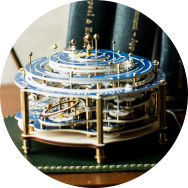
Inspired by 18th-century Grand Orreries and incorporating the design of mechanical wristwatches,
this is a mechanical orrery that lets you enjoy the motion of intricate gear mechanisms.
It simulates planets, comets and the phases of the Moon.
captures the romance of the cosmos
of mechanical wristwatches
with a choice of three colors

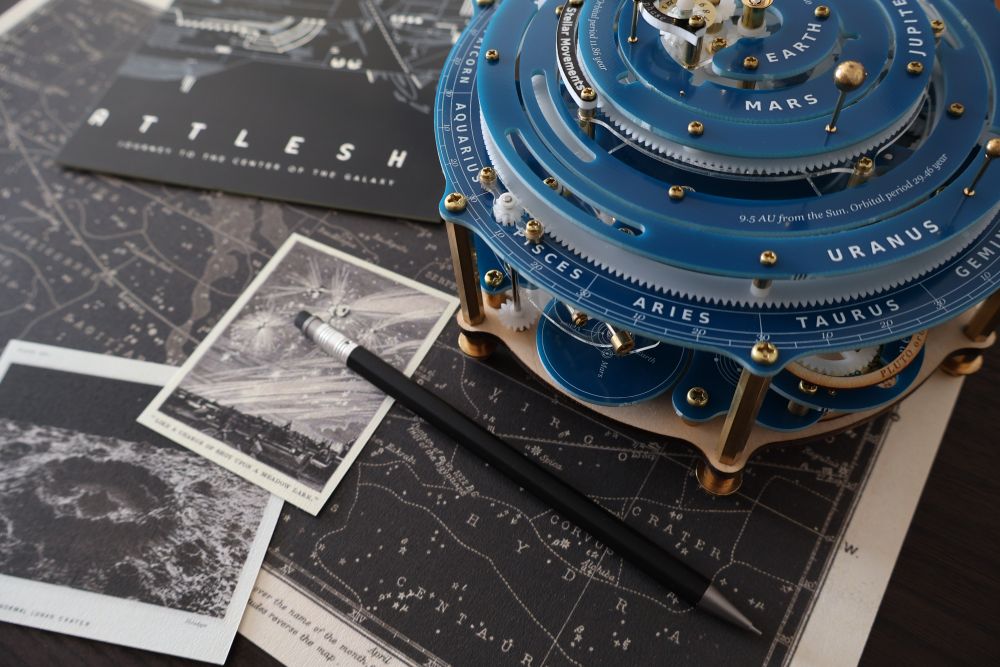
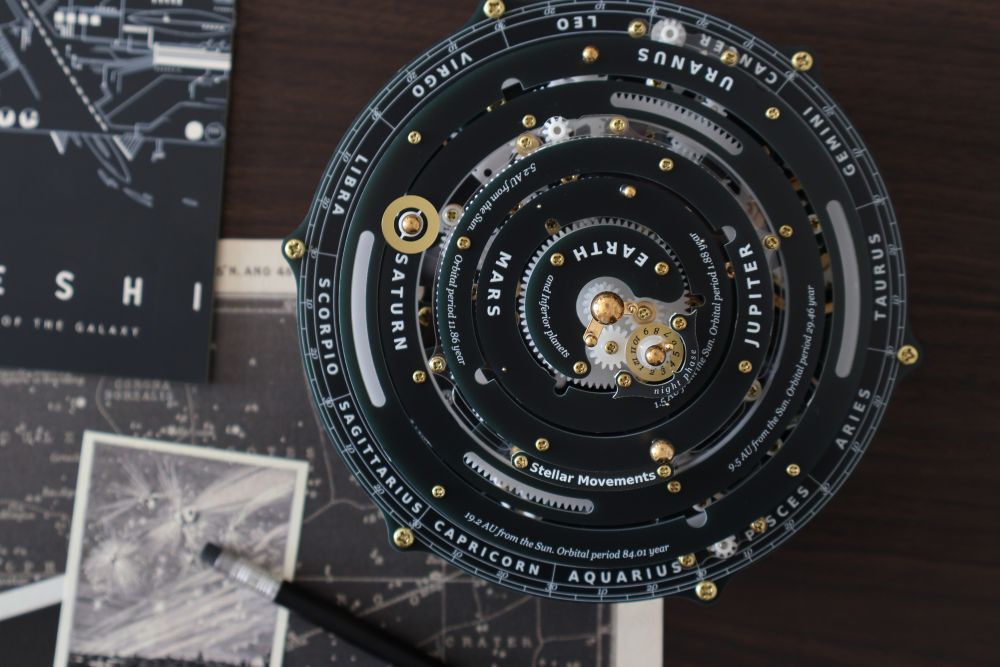
Overview of Stellar Movements

Among them, those that include the outer planets beyond the asteroid belt are specifically referred to as Grand Orreries, and Stellar Movements belongs to this category.
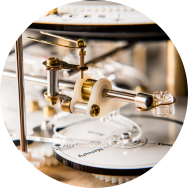
As the name suggests, Stellar Movements is designed with inspiration from the power mechanisms of mechanical wristwatches. It was created based on the concept of bringing the same sense of wonder found in a tourbillon watch into an orrery.
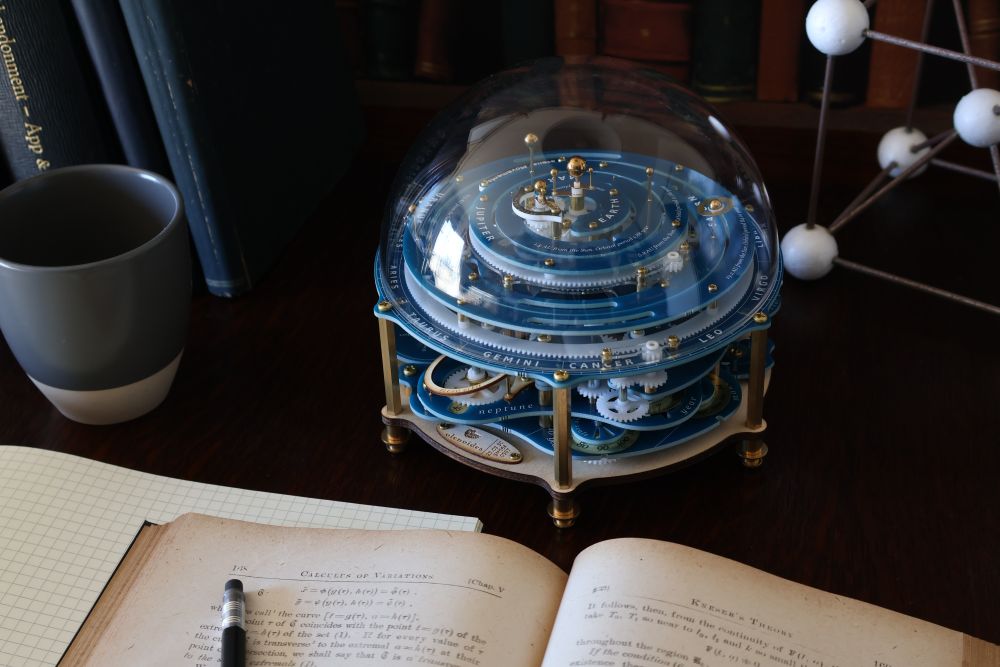
The overall form is inspired by 18th-century European Grand Orreries, while the internal mechanism incorporates design elements from mechanical wristwatches.
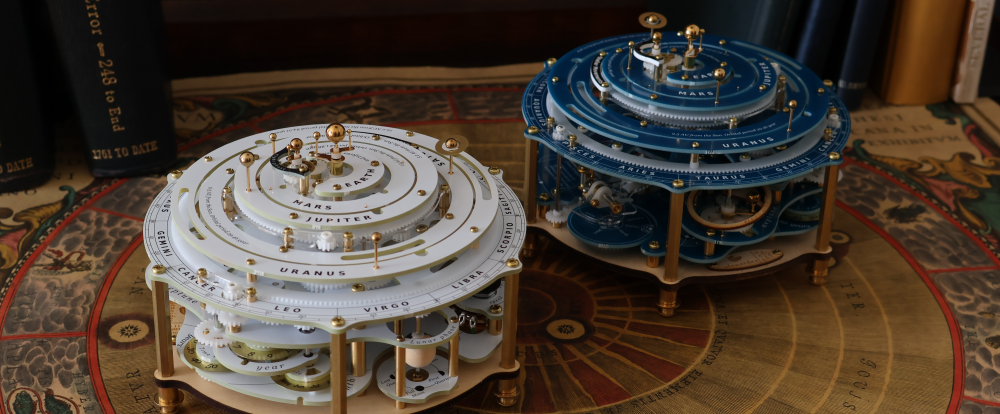
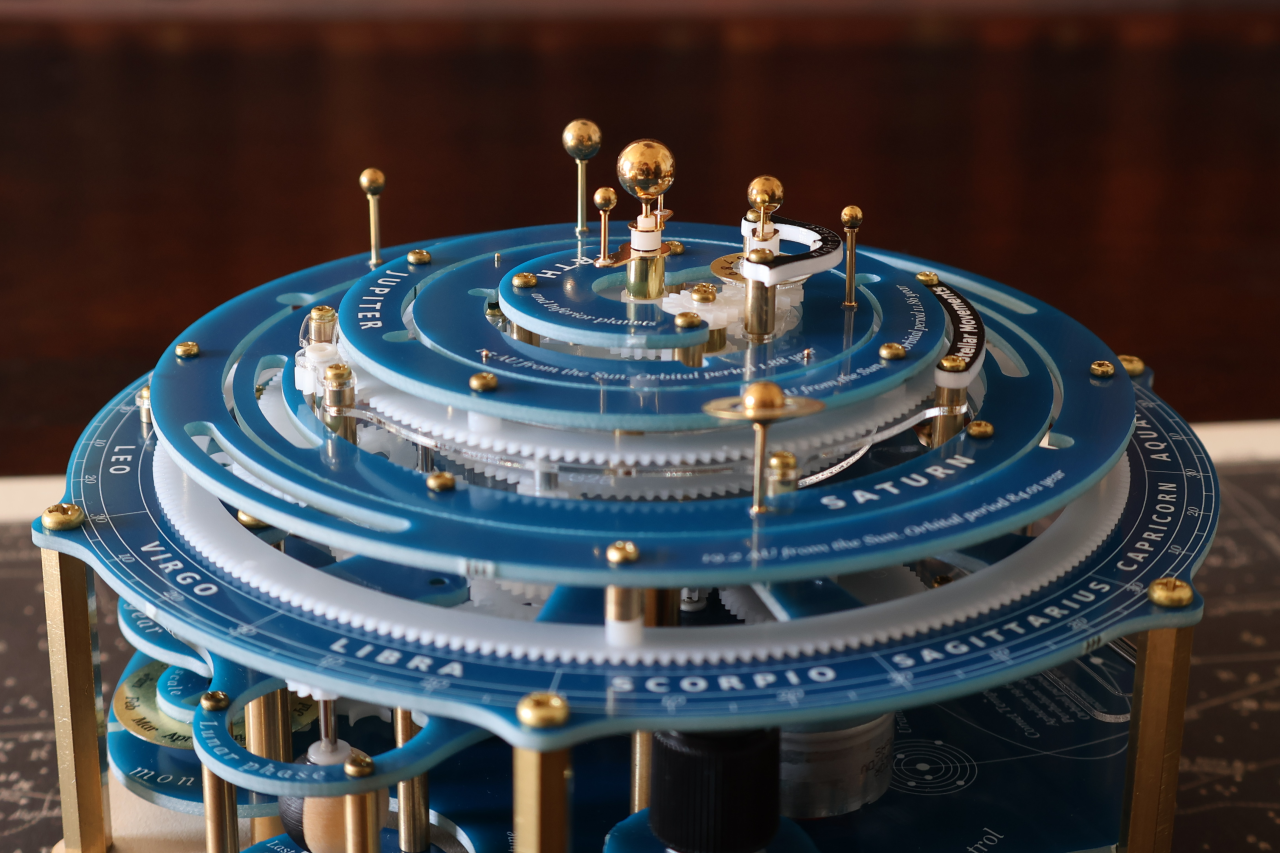
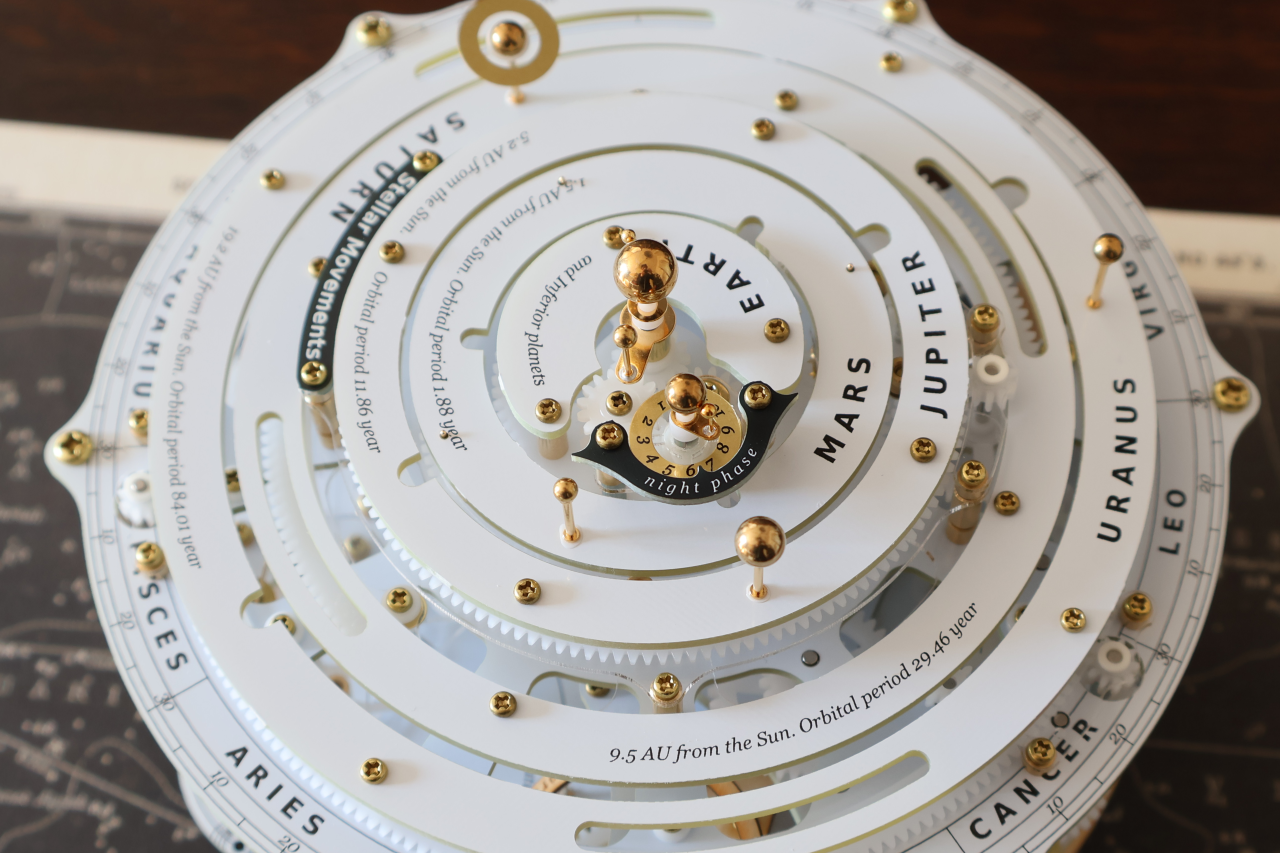
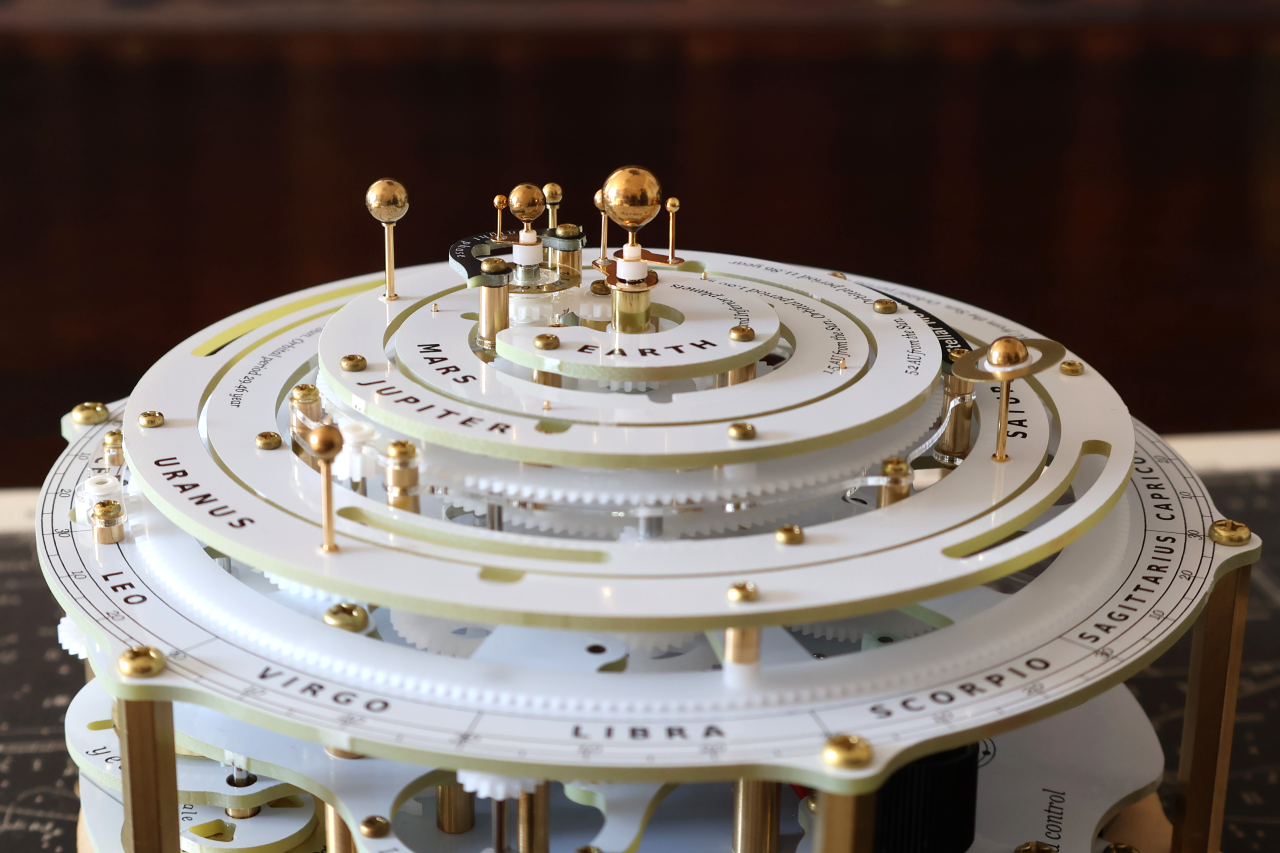
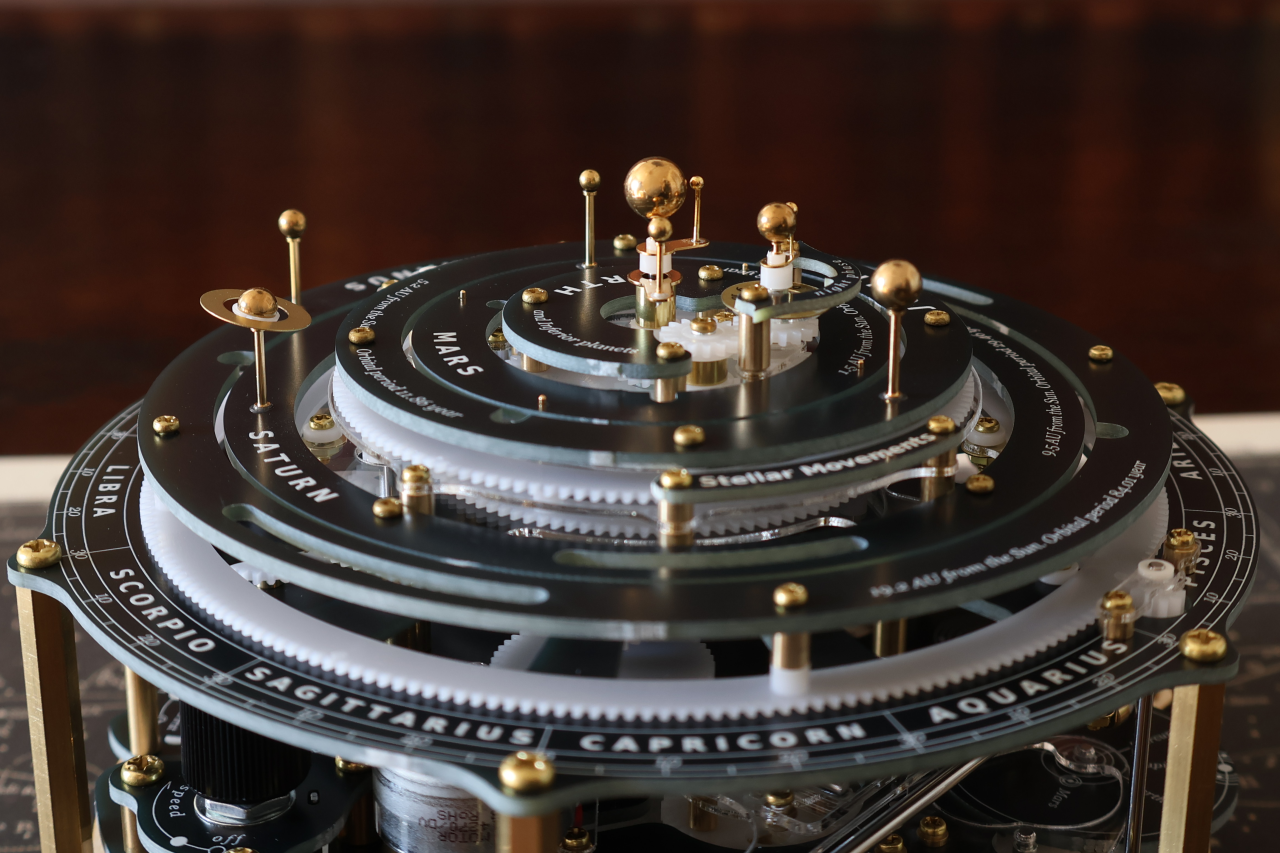
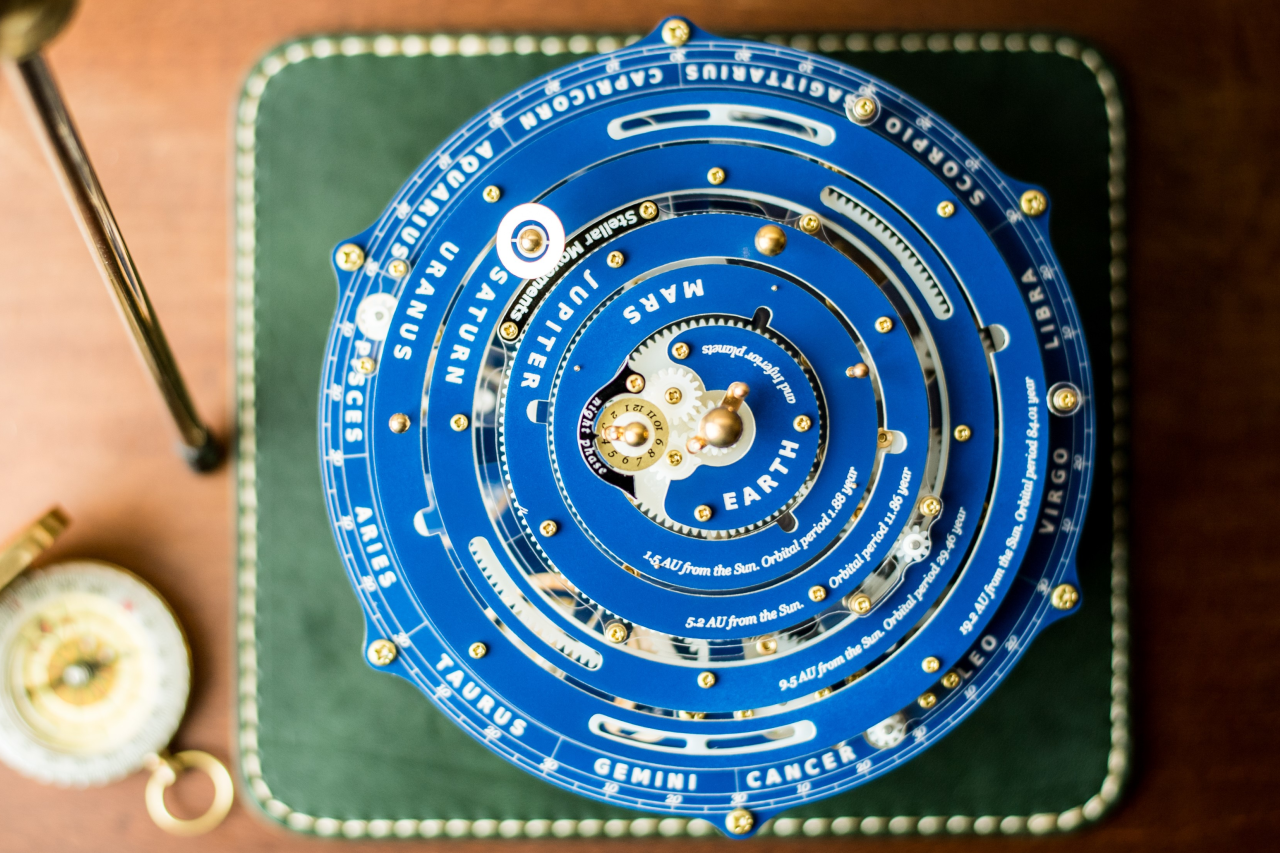
Like a traditional orrery, the top plate features seven planets up to Uranus, along with the Moon, all revolving via motor-driven motion.
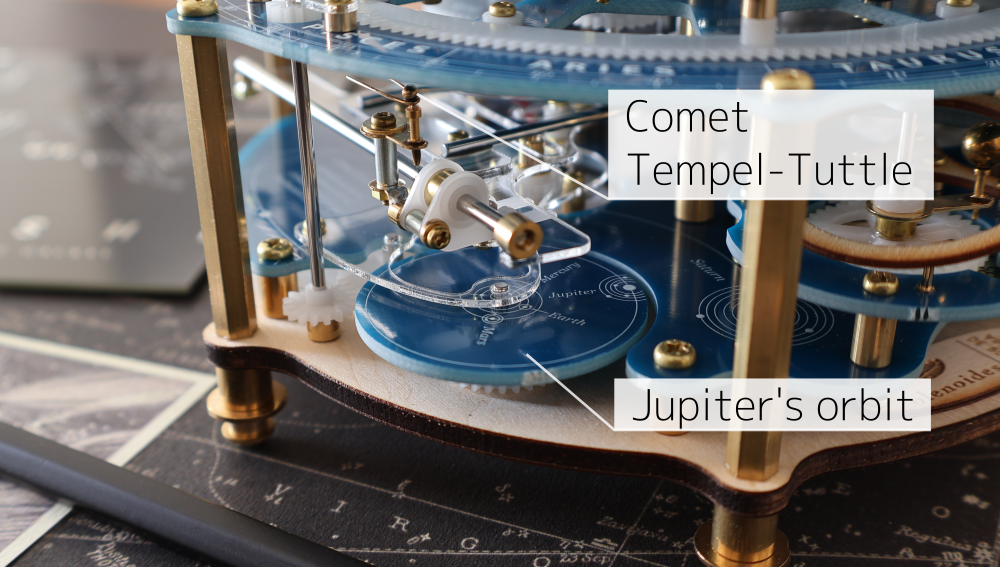
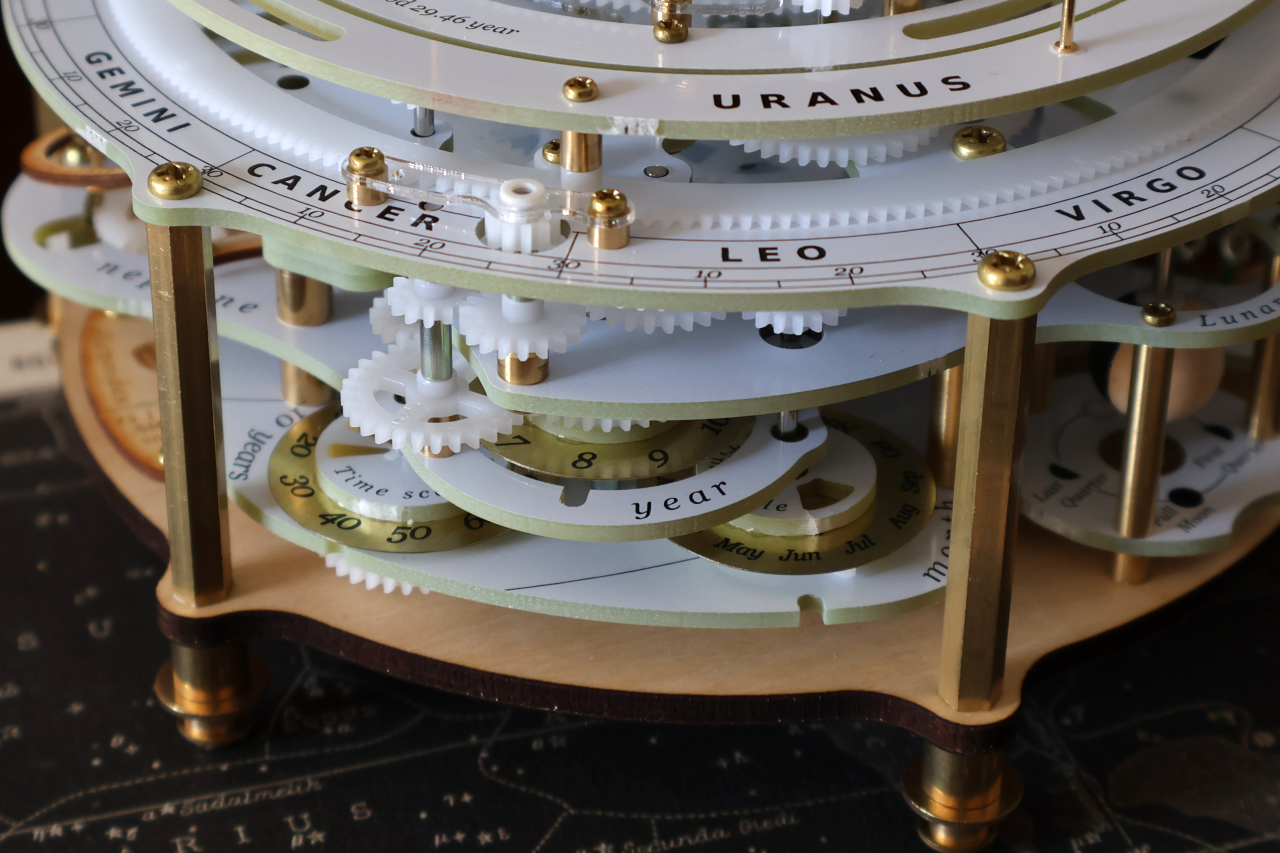
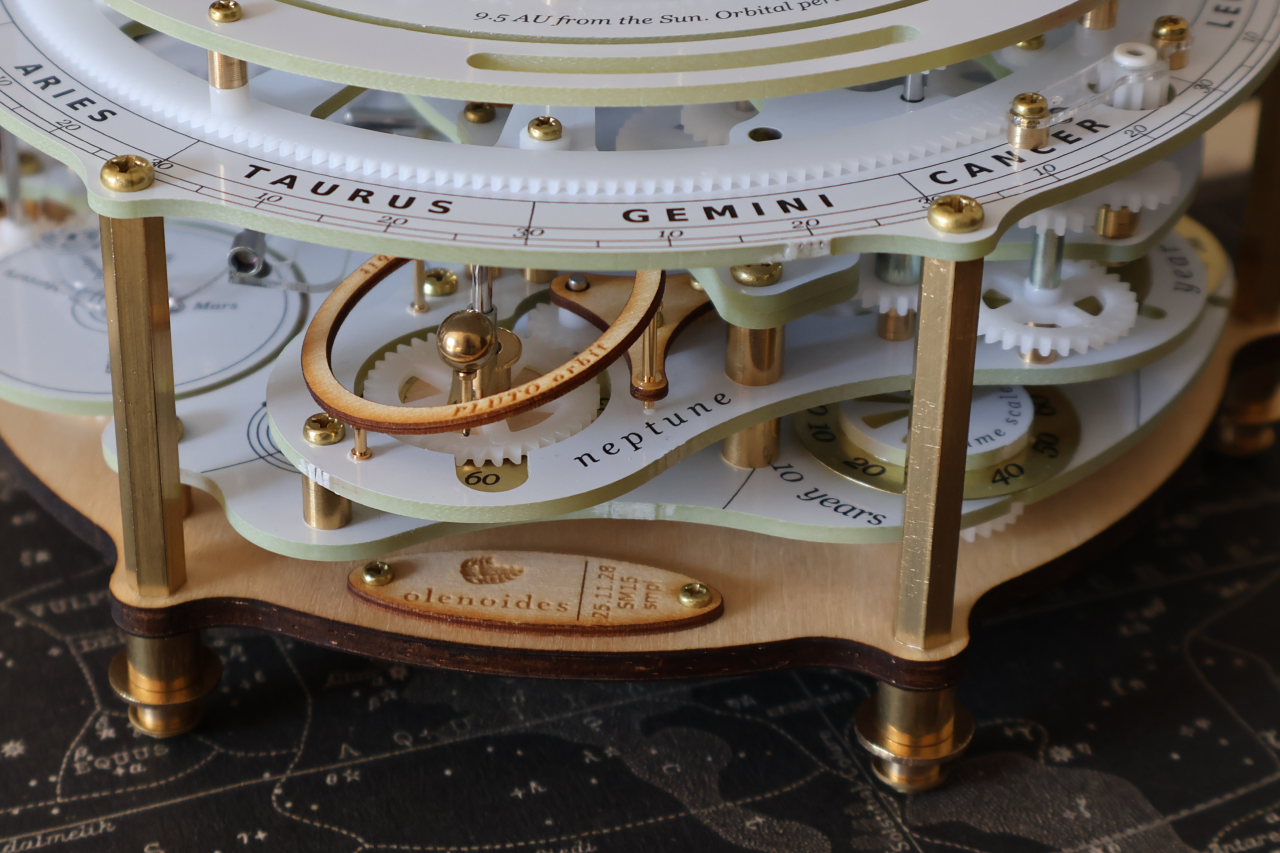
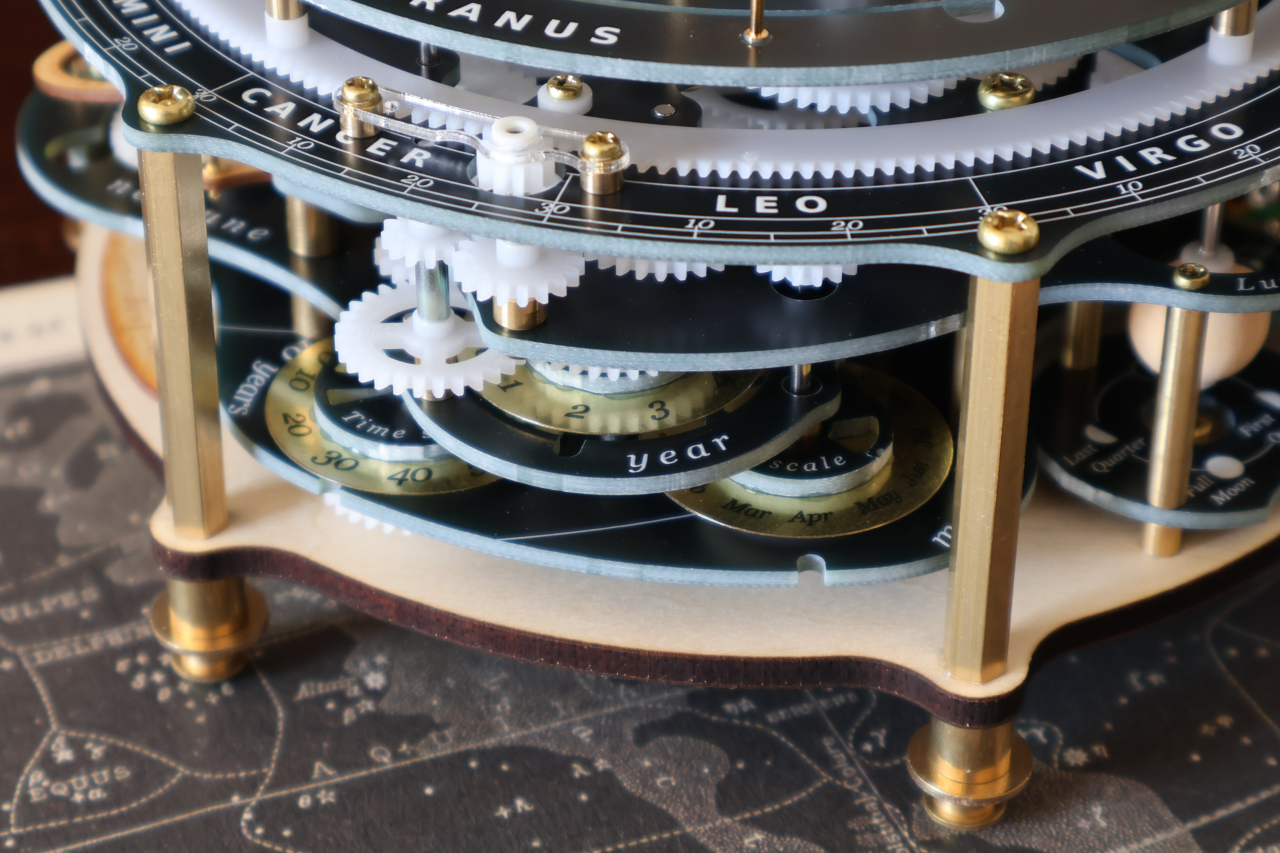
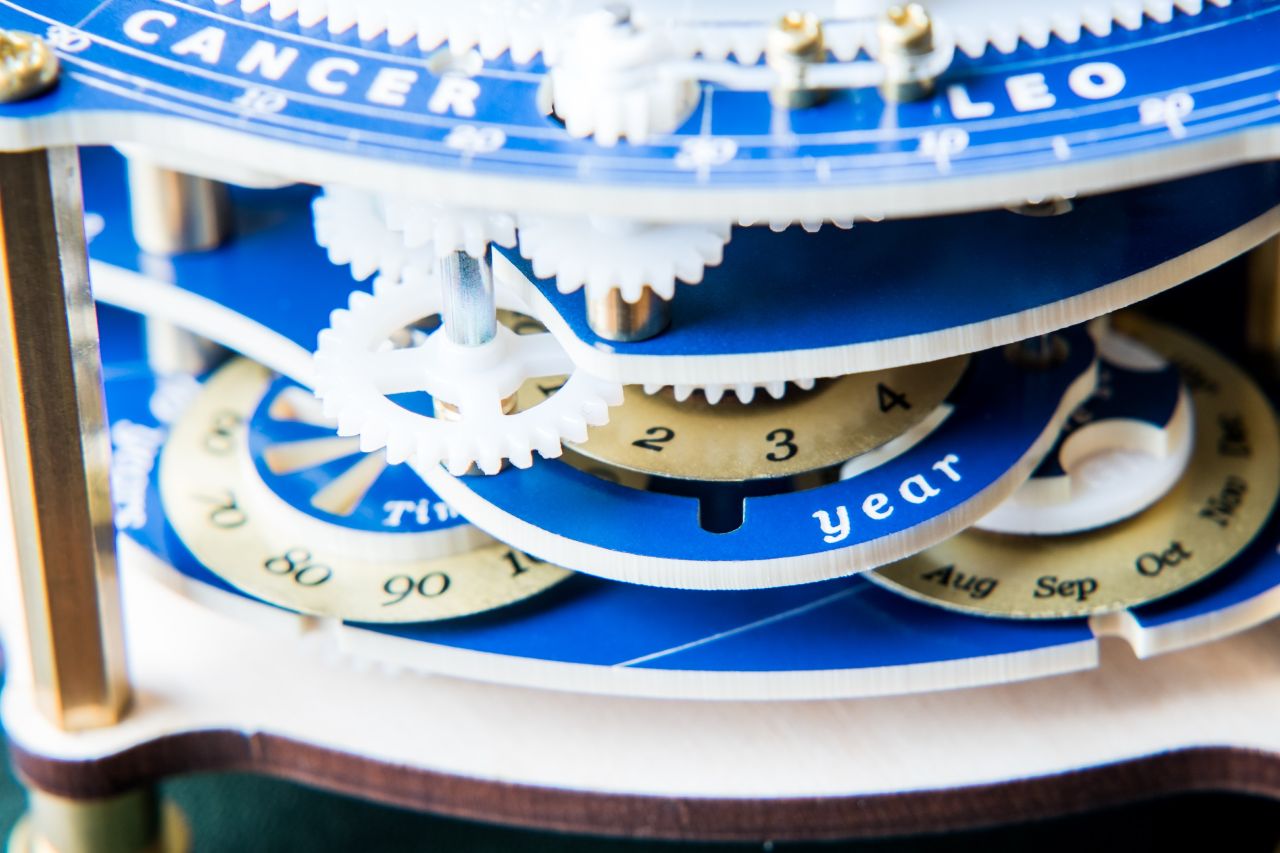
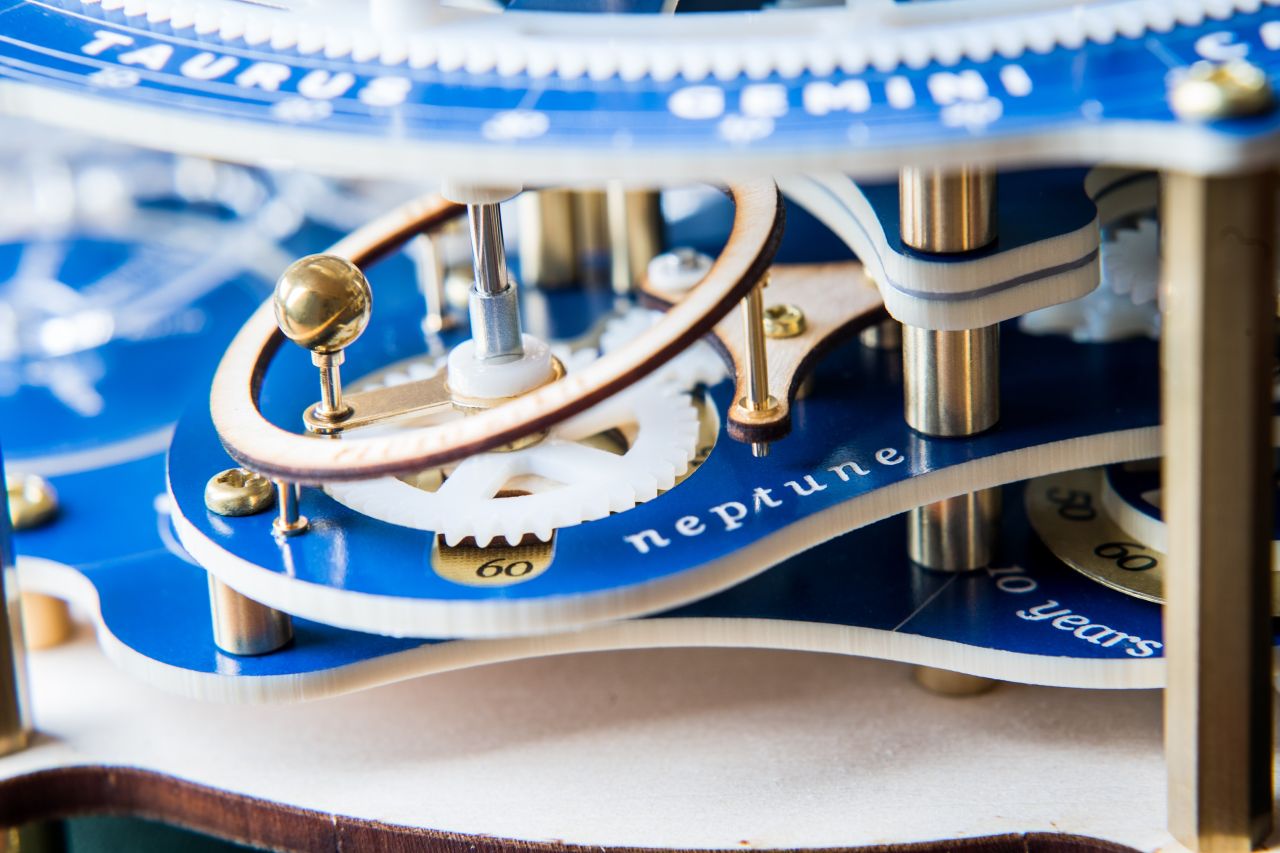
Beneath the top plate, unique features include Neptune, the comet Tempel–Tuttle, lunar phases, and a time scale, all moving in synchronization with the planets above.
In particular, the comet Tempel–Tuttle follows an elliptical orbit—an innovative feature not found in conventional orreries—offering motion distinct from planetary orbits.
Power is supplied via a standard USB port, and its compact size allows it to fit comfortably in both hands.
This makes it easy to place on a desk or shelf, much like a clock, without worrying about space or power access.
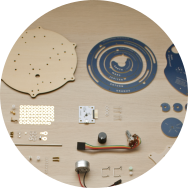
Although the product is assembly-based, it does not require advanced technical skills and is designed so that anyone can assemble it with ease.
Six Key Features
— 1. Top Plate
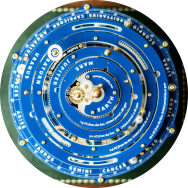
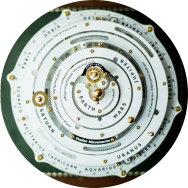
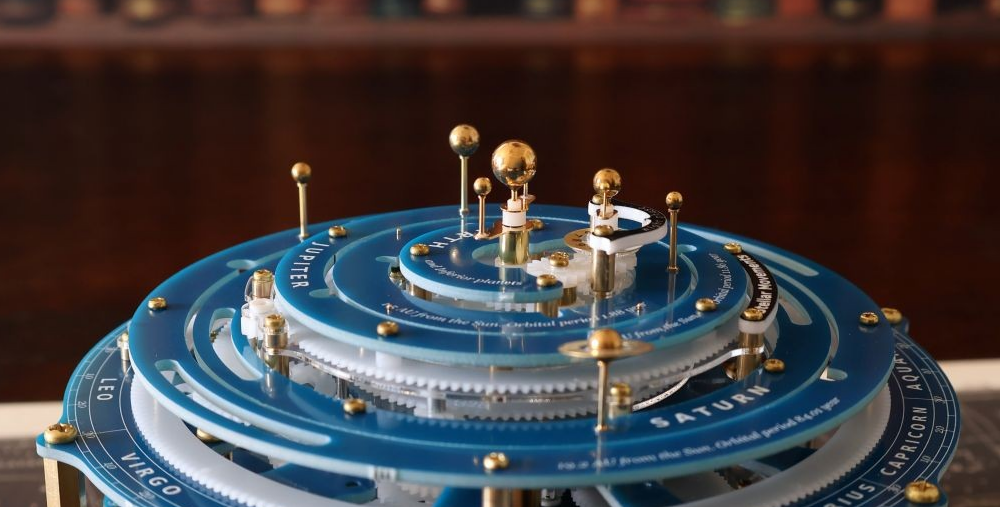
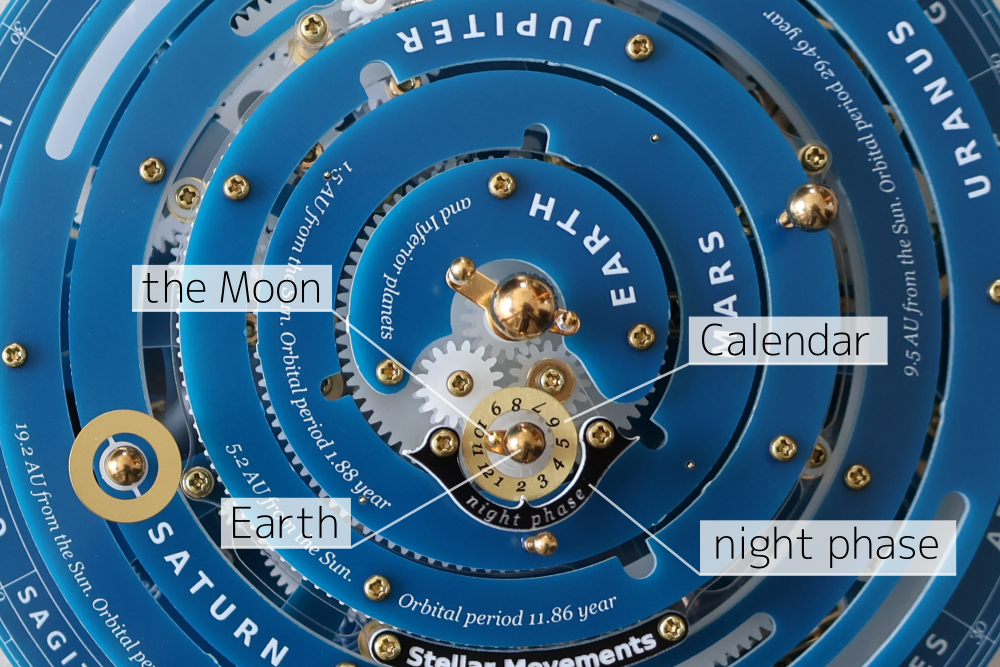
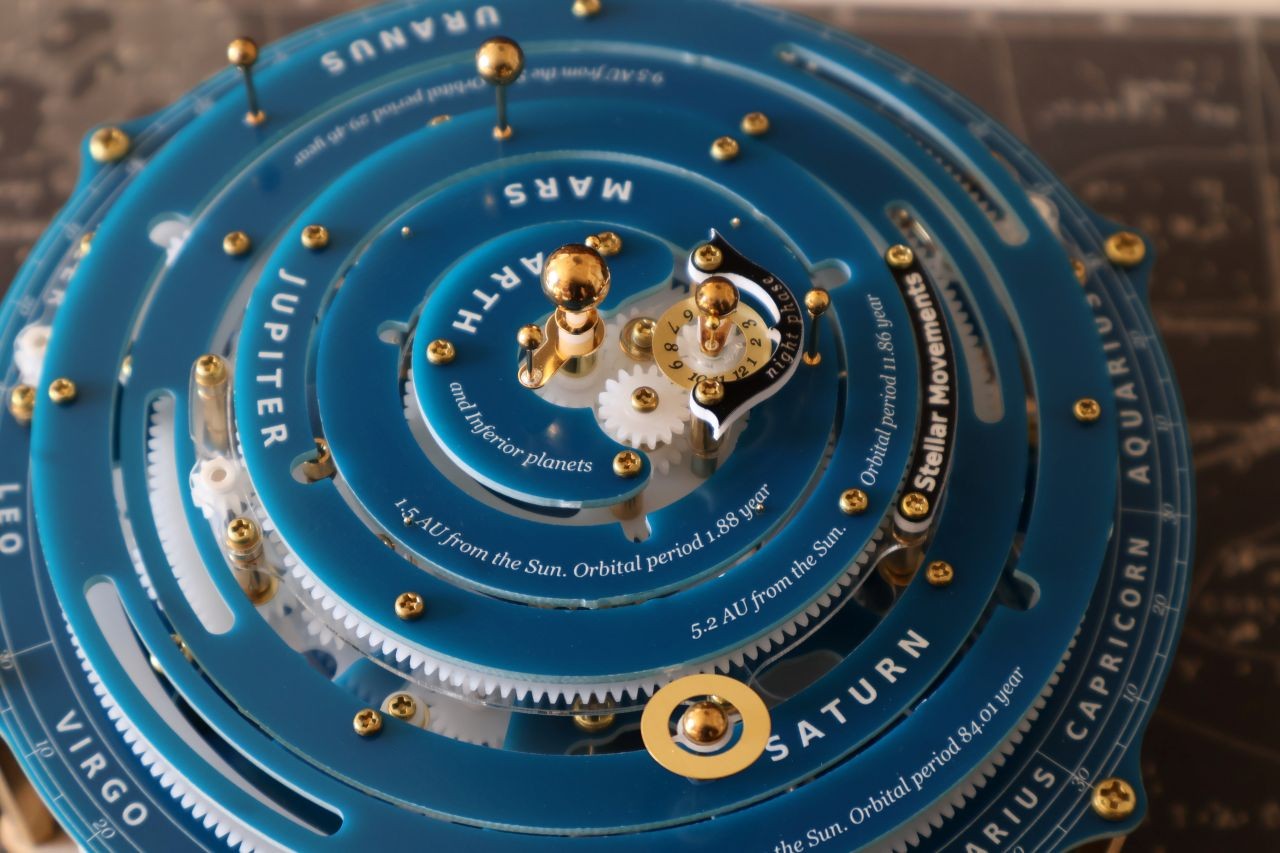
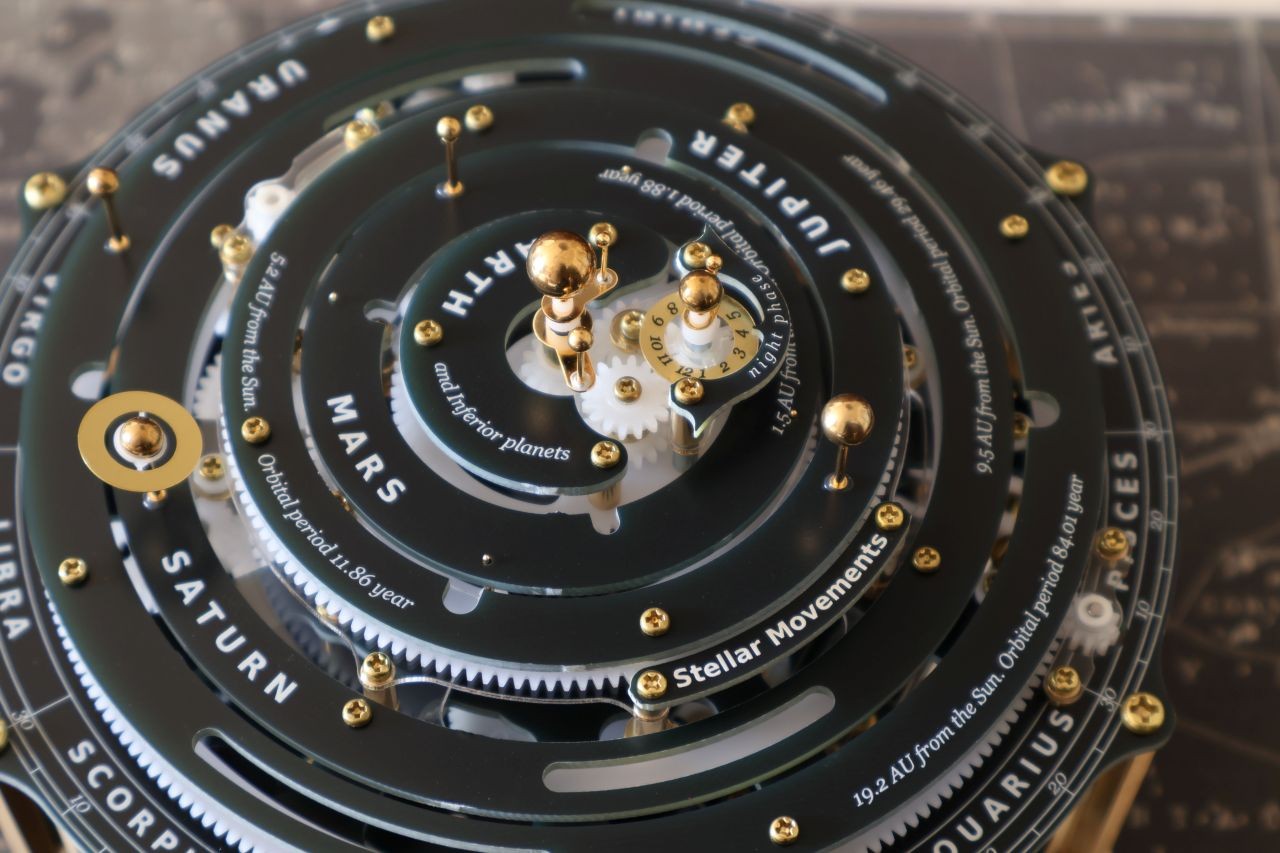
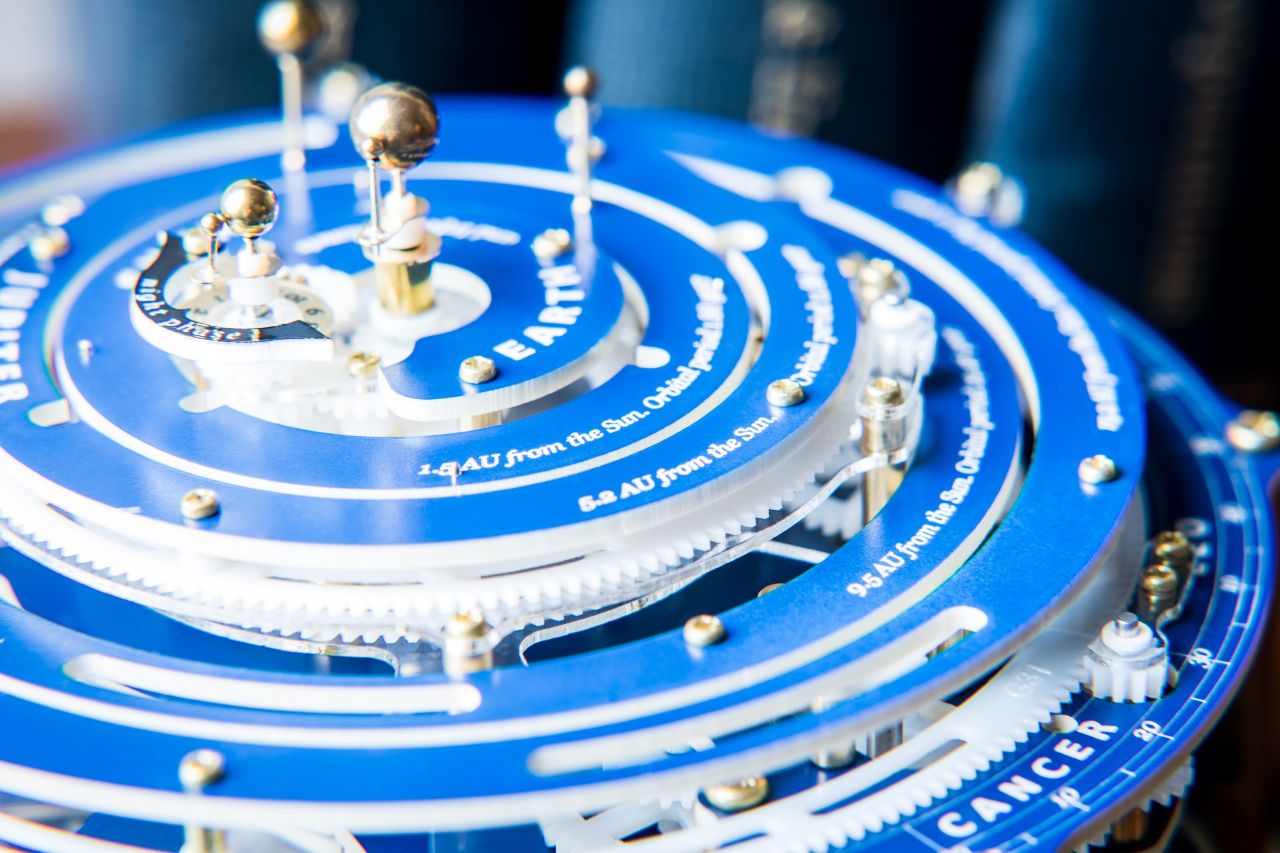
Centered around the Sun, Mercury, Venus, Earth (with its Moon), Mars, Jupiter, Saturn, and Uranus revolve in orbit.
The ecliptic plane along which the planets orbit is rendered in three dimensions, allowing the internal gear mechanism to be clearly visible as part of the design.
Around the Earth, a “night phase” indicator shows the position of nighttime.
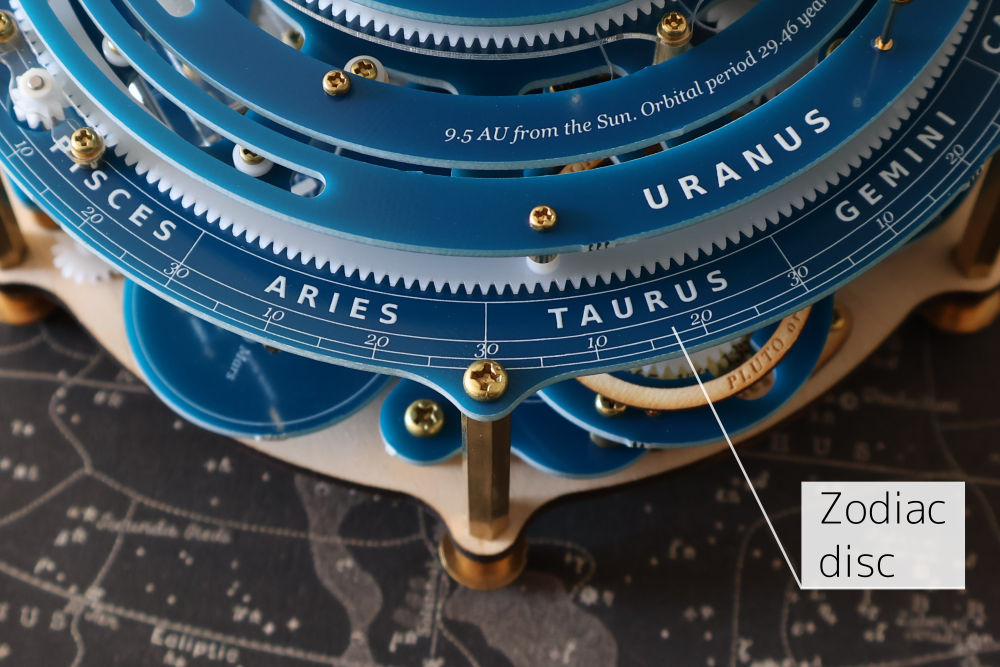
In addition, the calendar and zodiac disc allow you to identify the approximate date and its corresponding constellation.
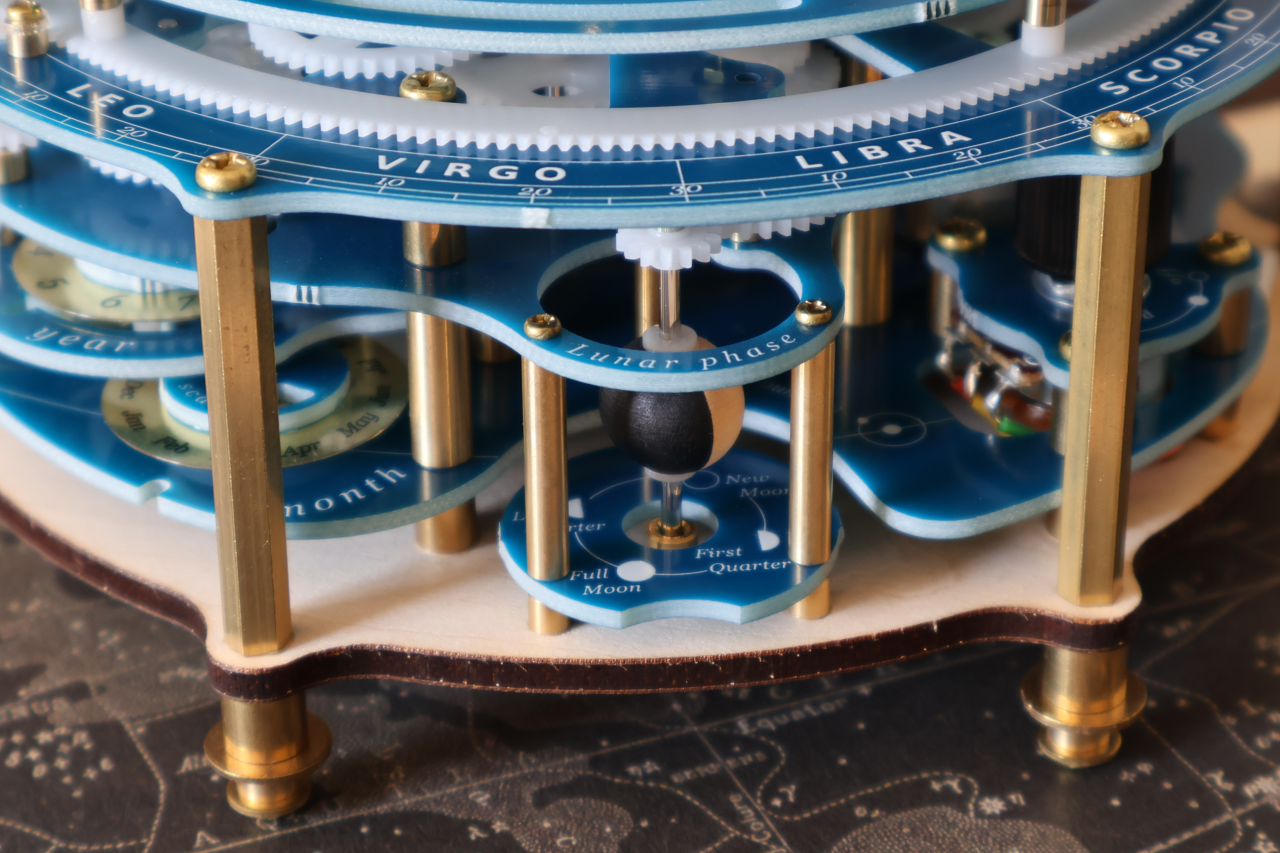
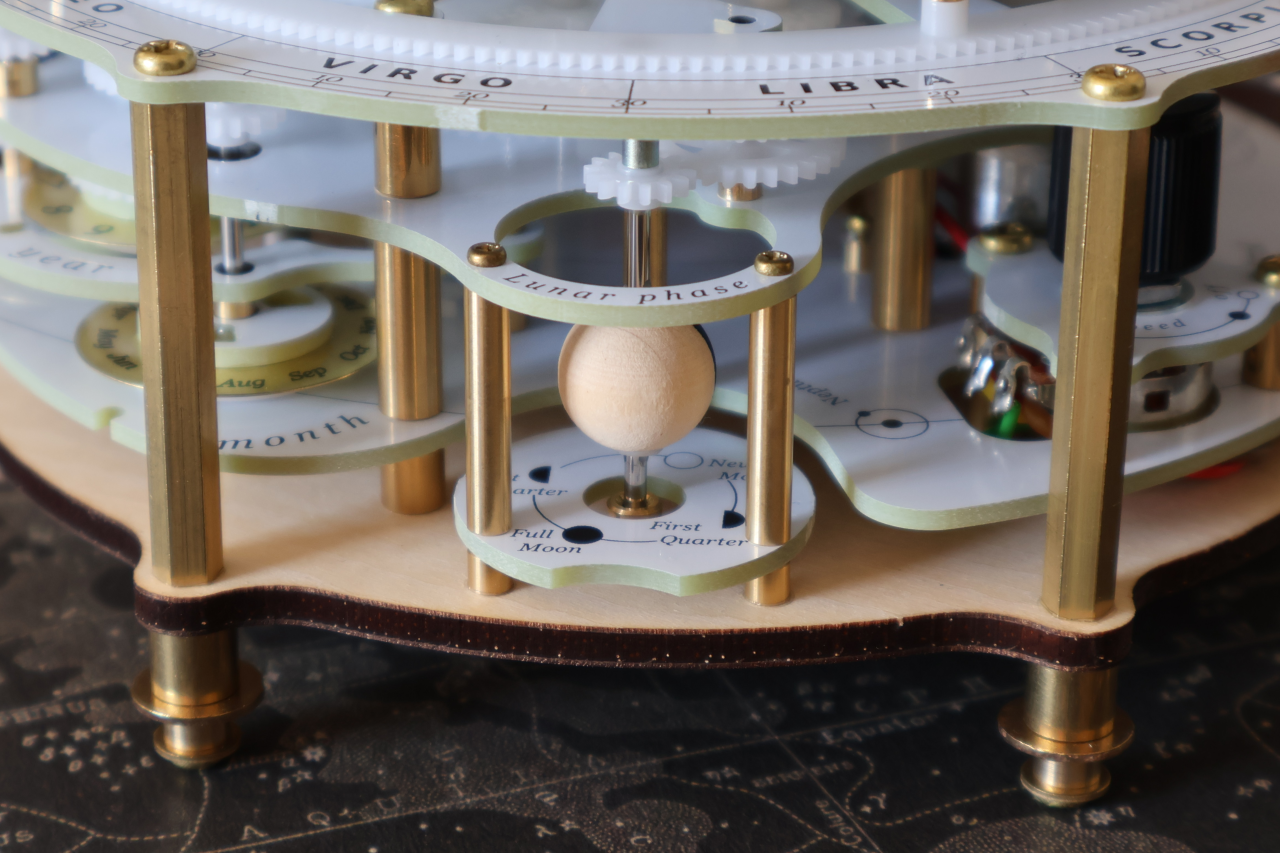
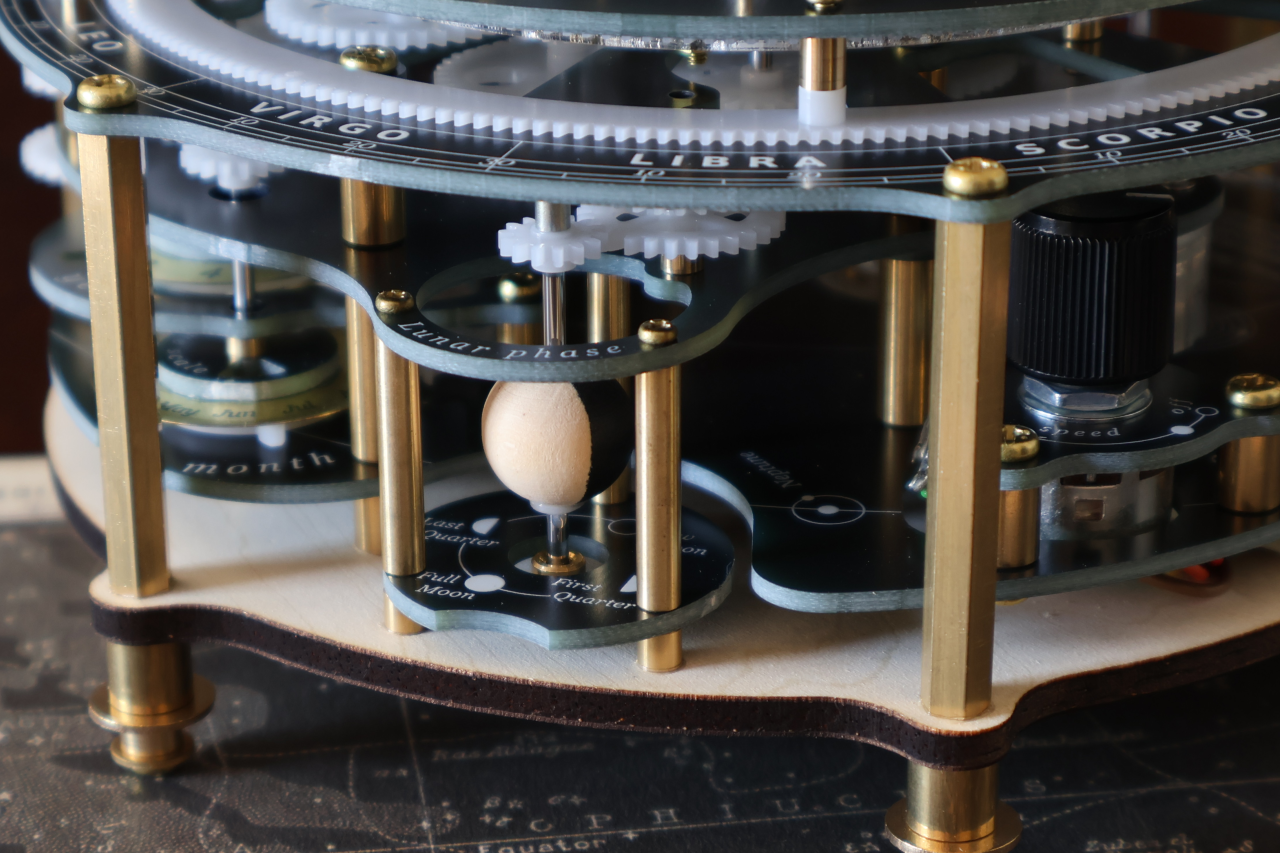
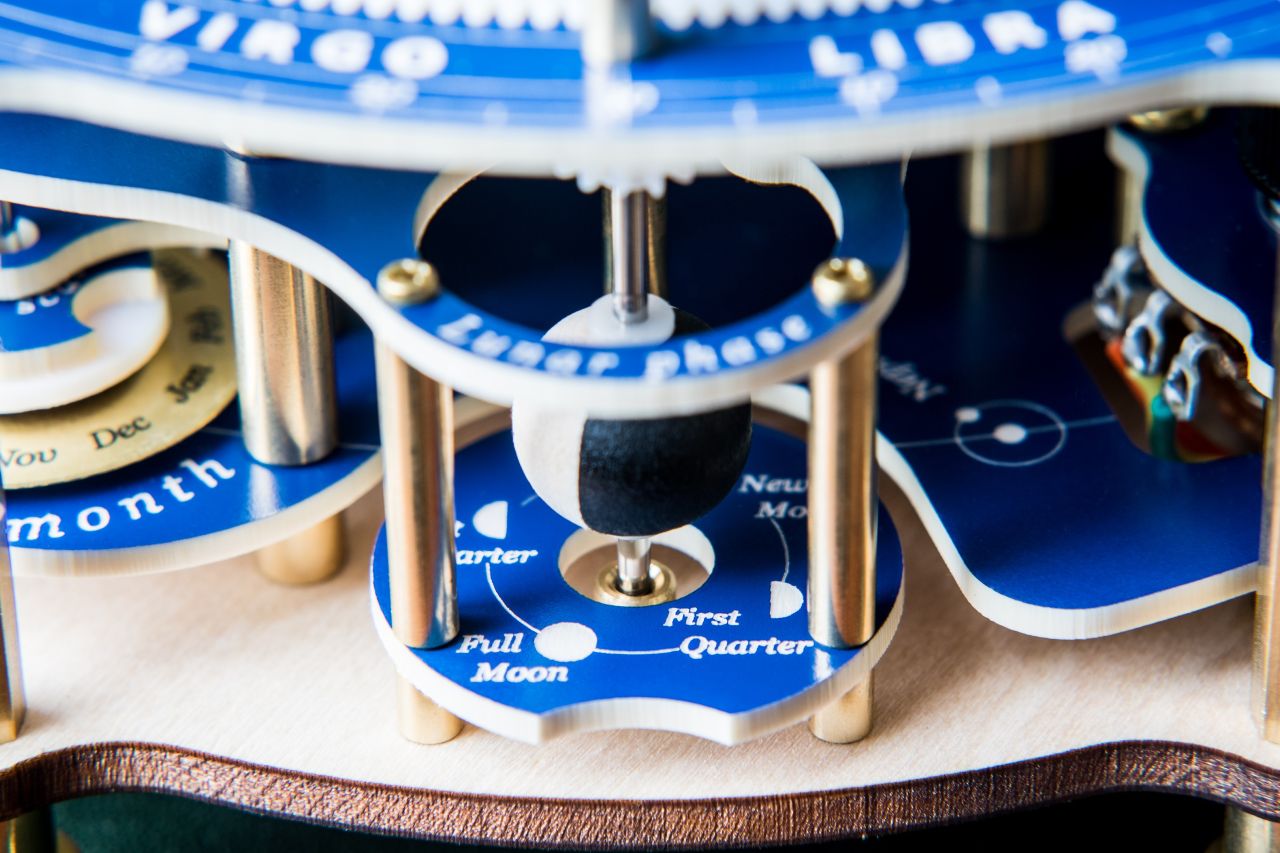
— 2. Lunar Phase
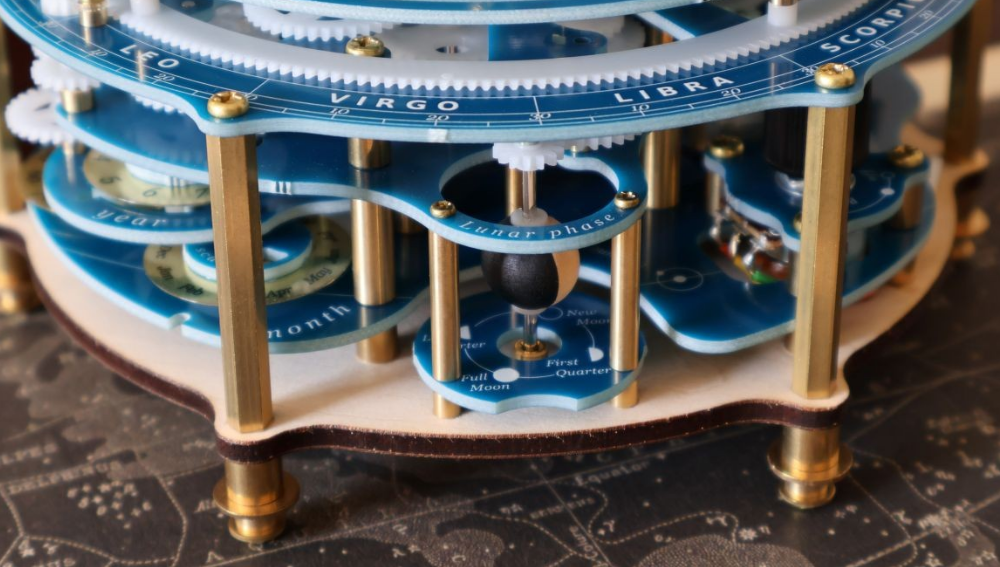
The phases of the Moon are displayed in synchronization with the Moon on the top plate.
On Stellar Movements, the lunar cycle completes one full rotation in approximately 29 days according to the time scale.
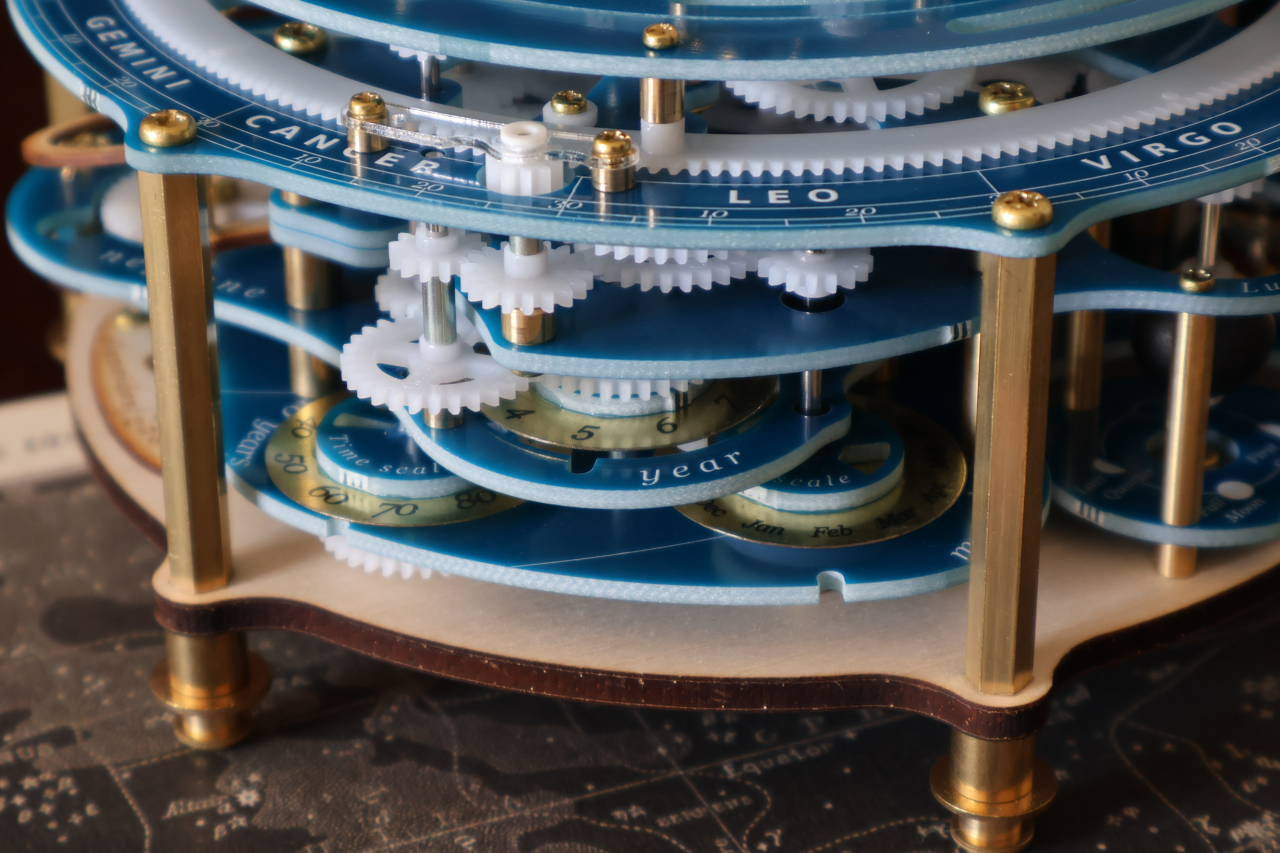
— 3. Time Scale
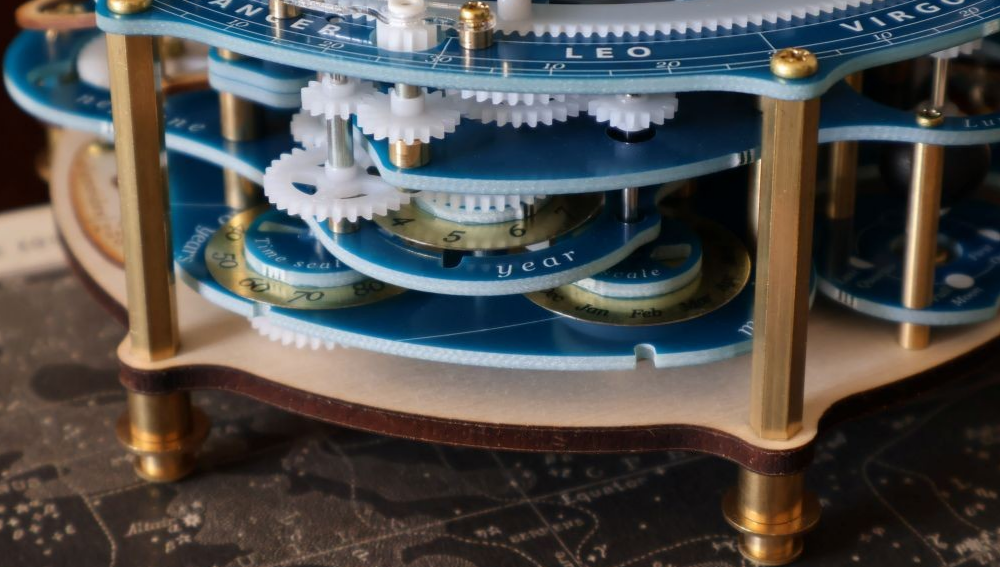
The time scale can be read using three rotating discs:
* Month (monthly scale)
* Year (annual scale)
* 10 Years (decadal scale)
The monthly scale moves in conjunction with the calendar on the top plate.
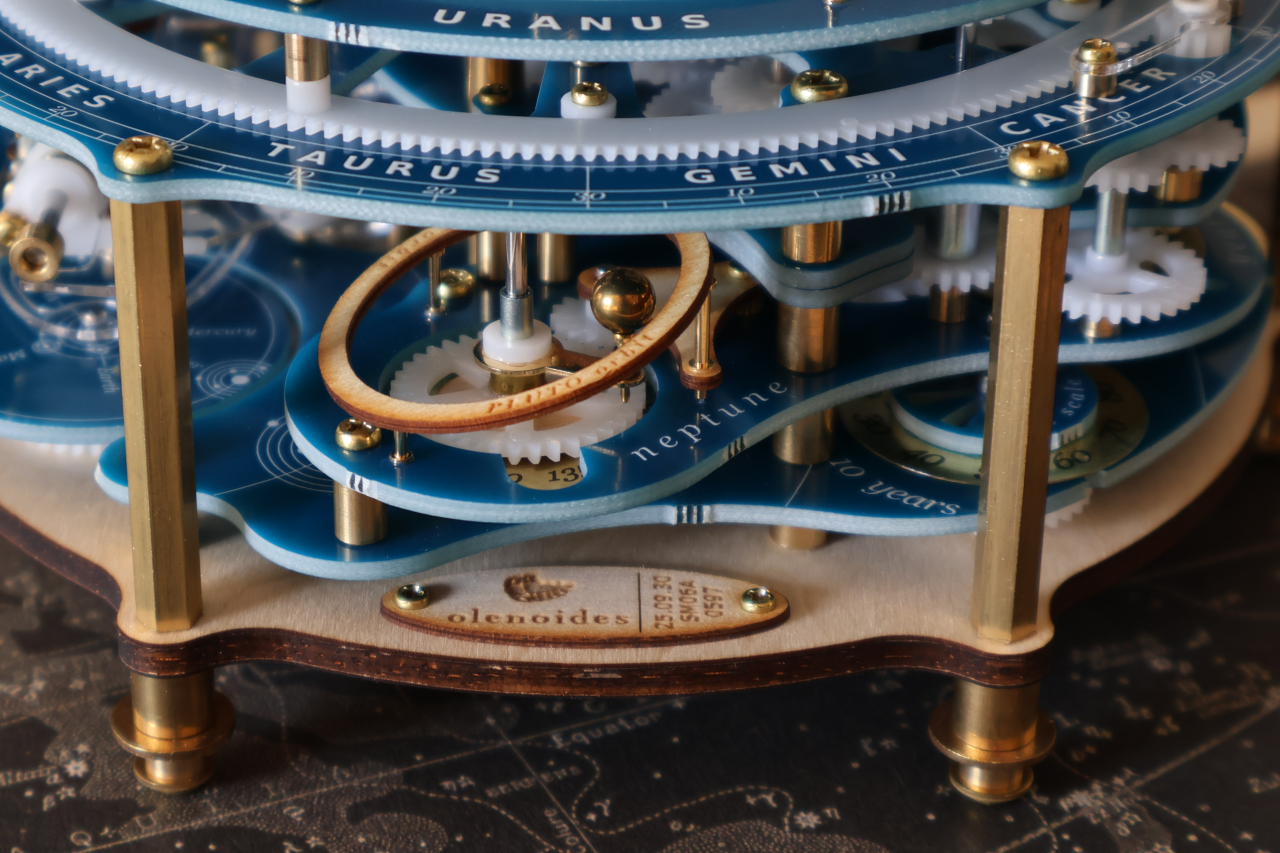
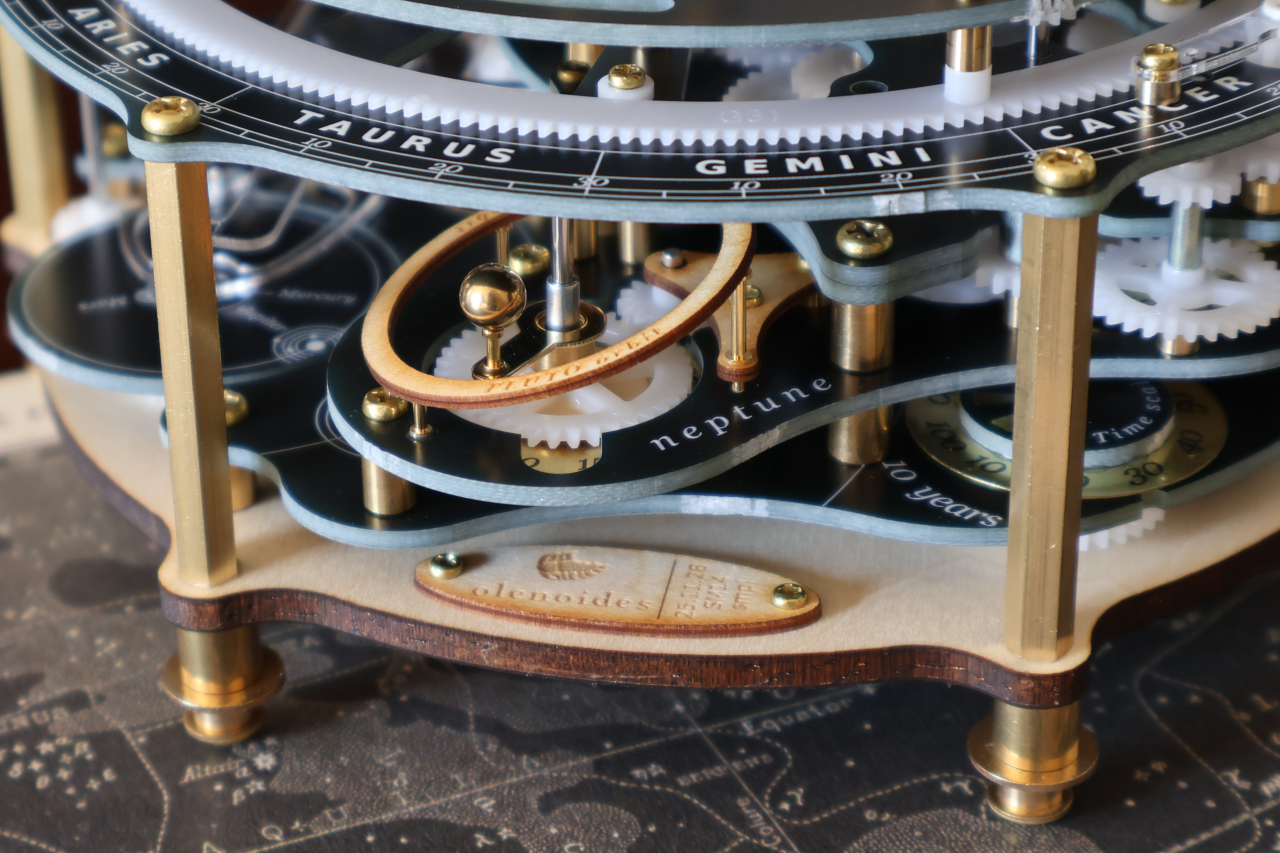
— 4. Neptune
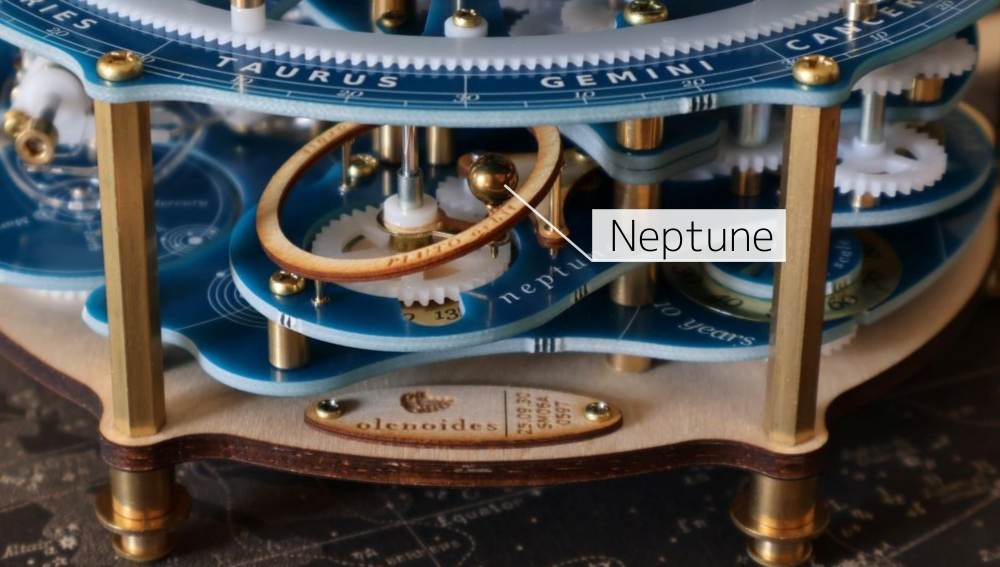
Because Neptune, which orbits at the outermost edge of the solar system, moves very slowly, it is placed on a separate stage from the other planets.
On Stellar Movements, it is designed to advance one step every 10 years according to the time scale.
The ring surrounding Neptune represents Pluto’s orbit and is mounted with an orbital inclination of approximately 17 degrees.
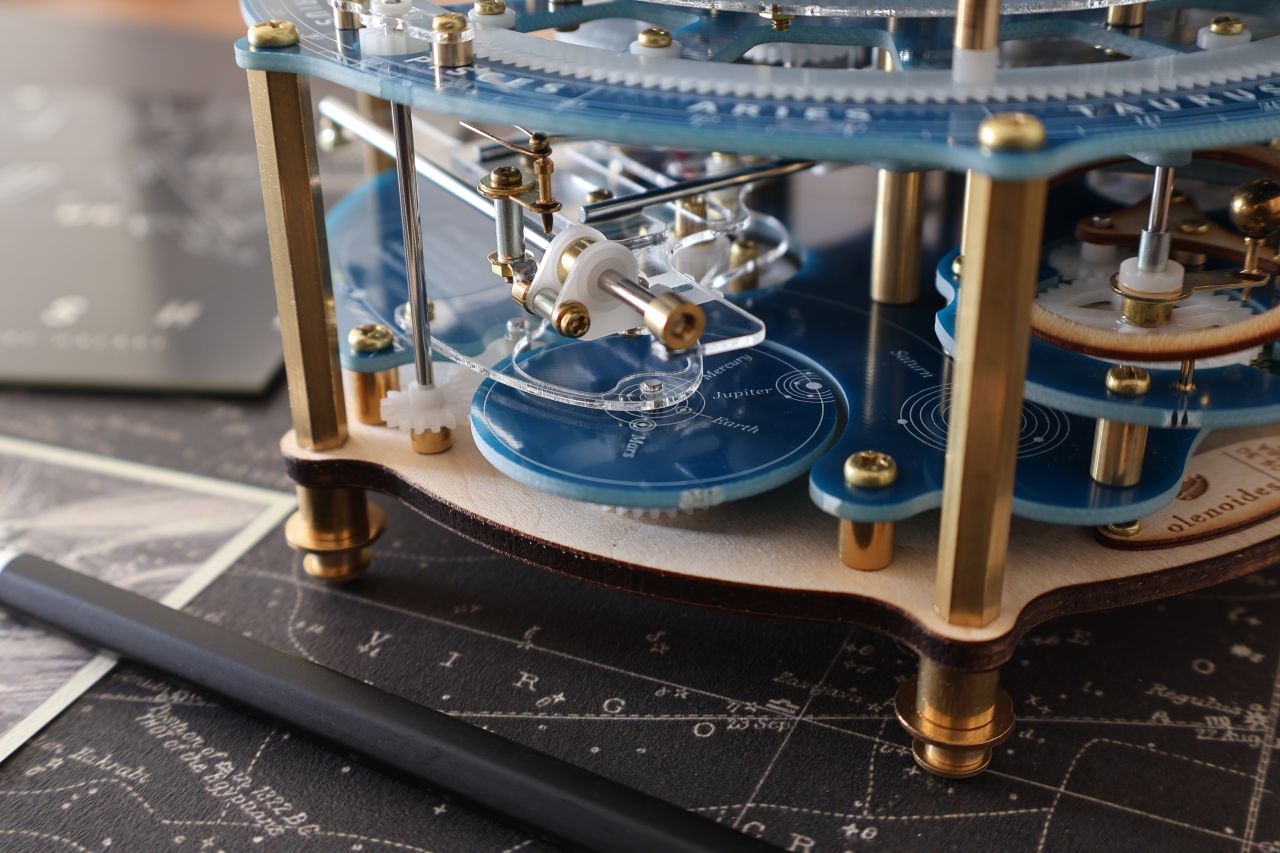
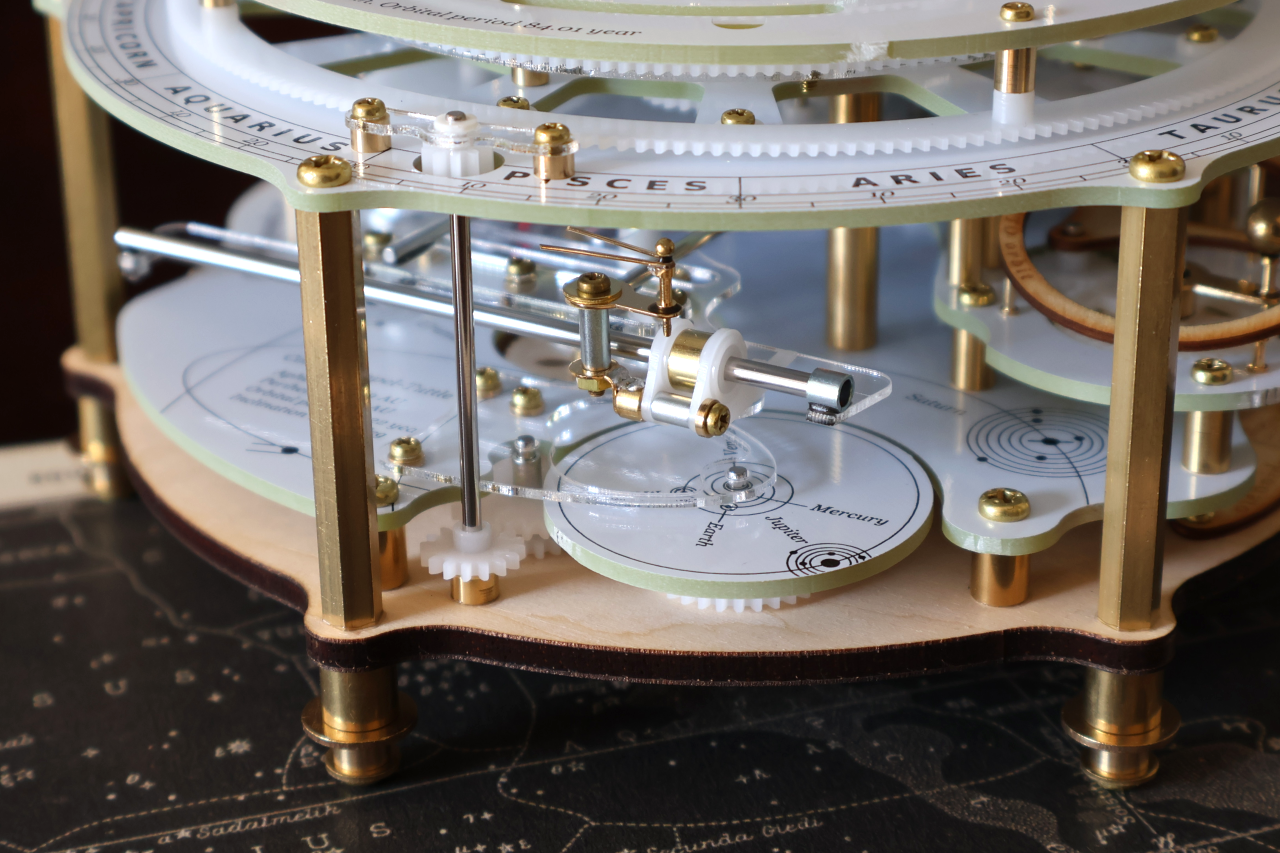
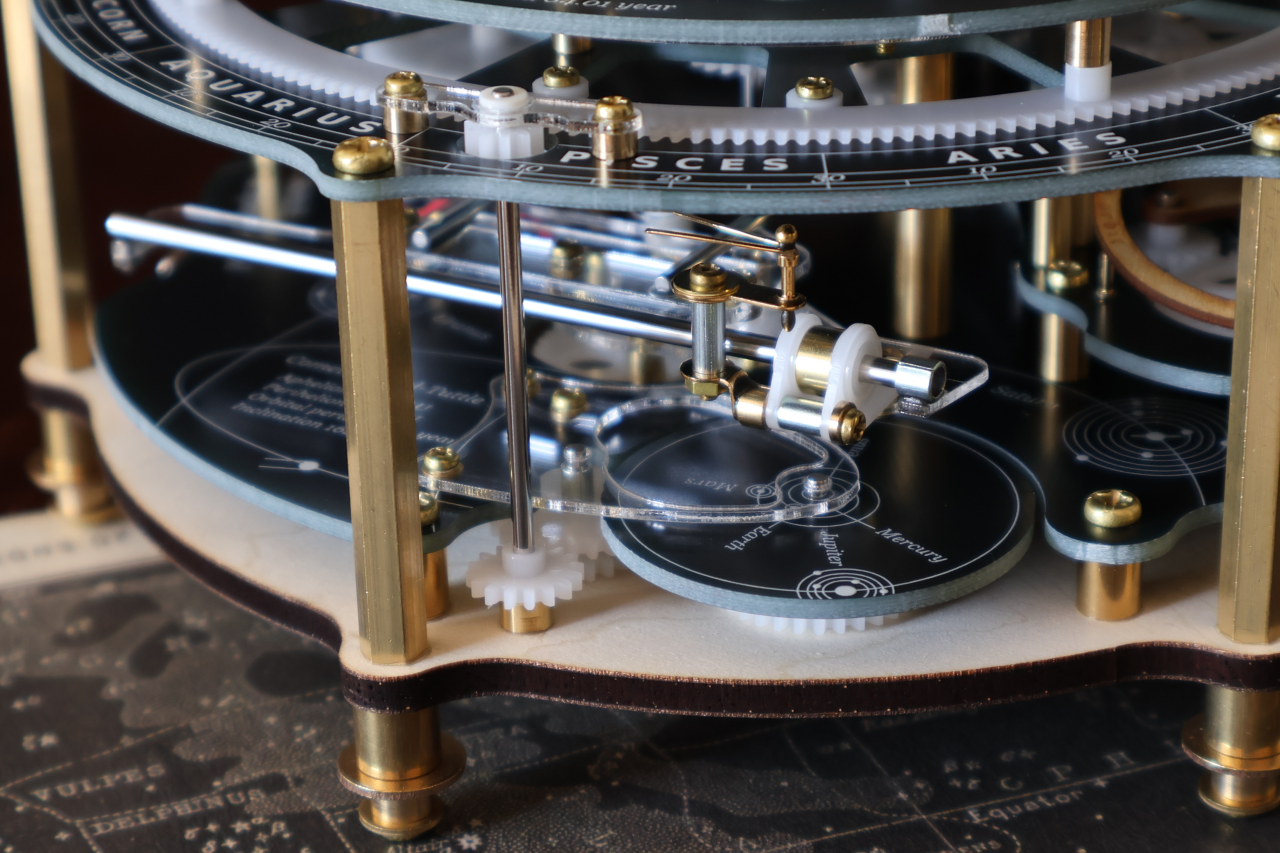
— 5. Comet Tempel–Tuttle
Tempel–Tuttle, known as the parent body of the Leonid meteor shower, travels along an elliptical orbit and completes one revolution approximately every 33 years.
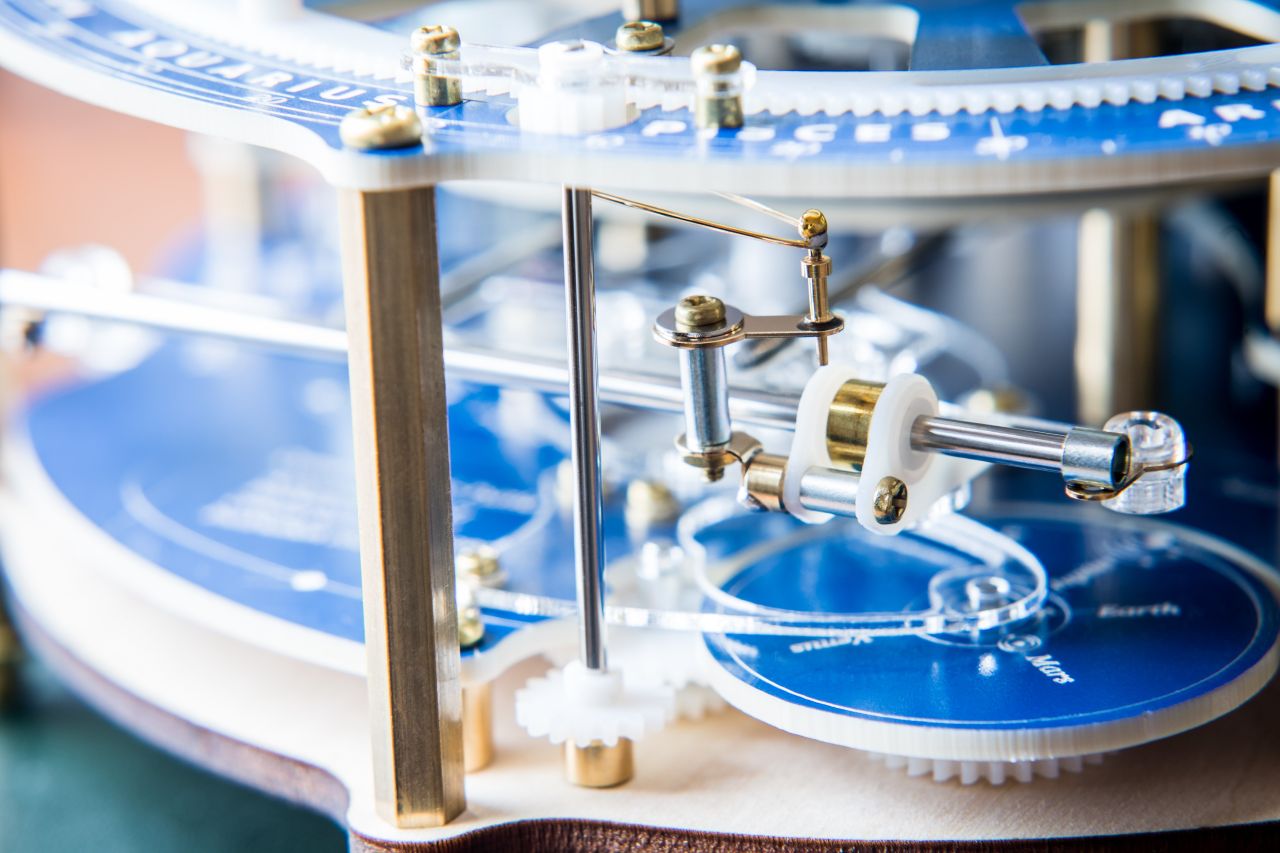
On the disc where the comet travels, the orbits of the planets are drawn to actual scale ratios.
Among them, Jupiter’s orbit rotates in synchronization with the comet.
— 6. Power and Speed Control
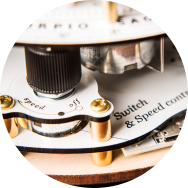
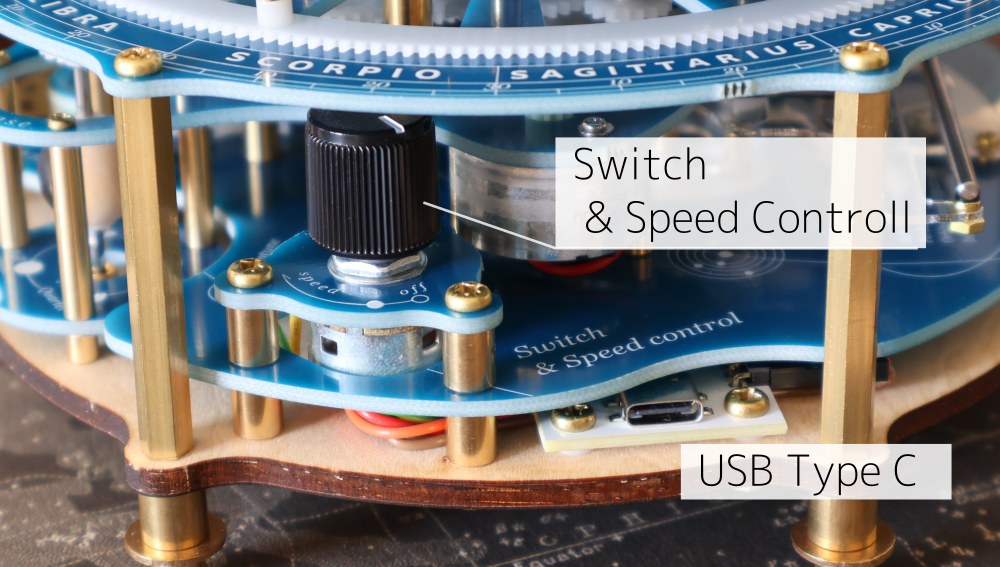
The orbital speed of the planets can be adjusted continuously using a control knob, which also functions as the power on/off switch.
Power can be supplied via a USB power source.
Specifications
| Size | Φ168 × 141 mm |
|---|---|
| Weight | Approx. 650 g |
| Materials | Brass, steel, acrylic, poplar core plywood, POM, etc. |
| Speed Adjustment | The length of one year can be adjusted between approximately 20 seconds and 1 minute 30 seconds. |
| Orbital Period Accuracy | Approx. 1% error (based on Earth’s orbital period) |
| Power Supply | USB Type C |
| Colors | Azure, Moon White, Dark Black |
Azure
Moon White
Dark Black
Blue(Old Ver.)
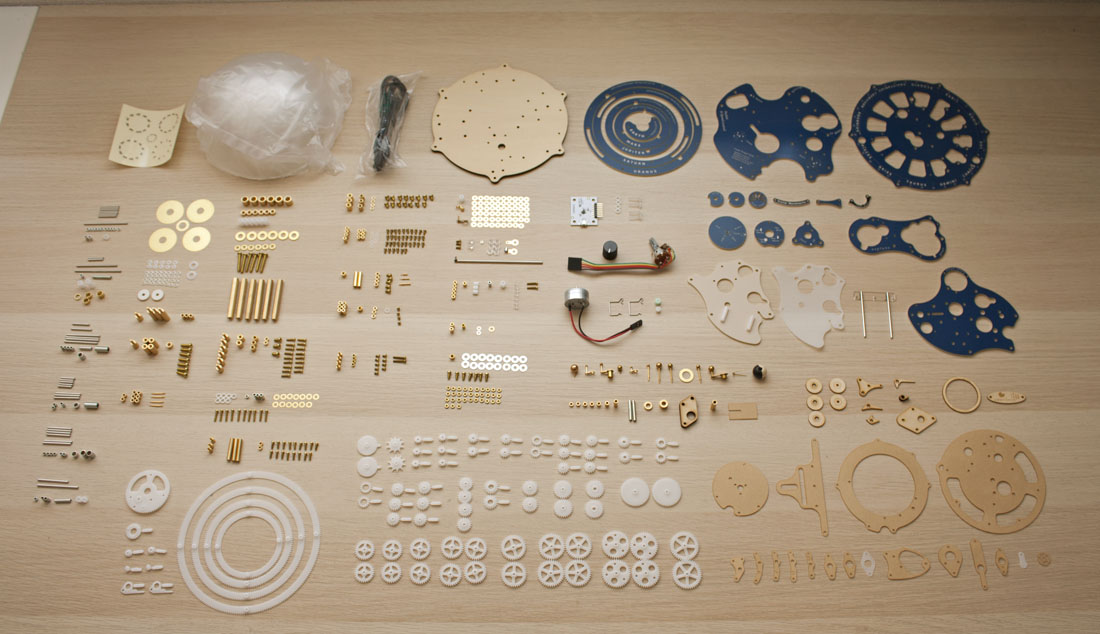
DIY Kit
You can assemble gears and mechanical components from scratch.
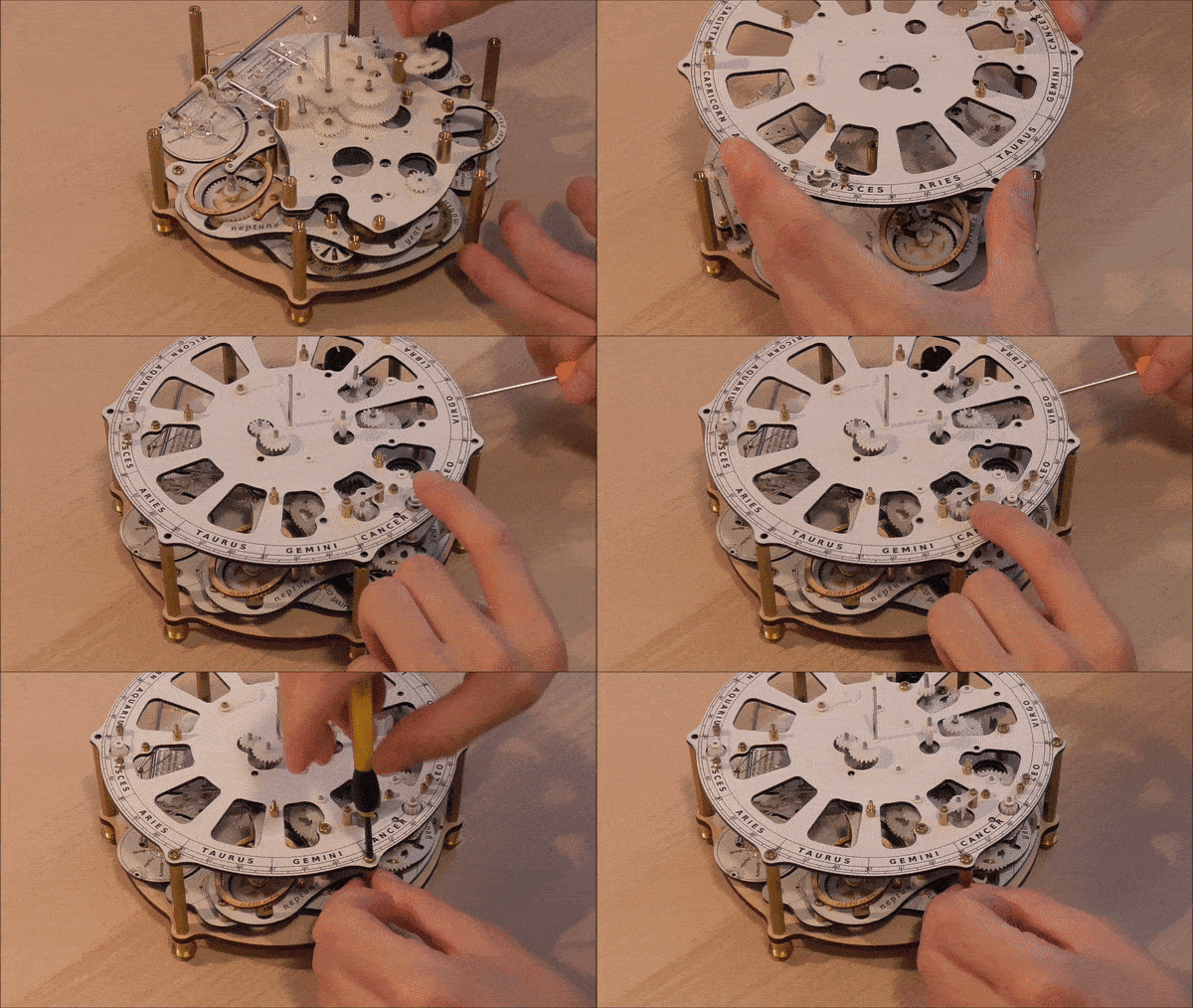
DIY manual
DIY manual for the Azure, Moon White and Dark Black version here
DIY manual for the previous versions (White, Blue) here.
English Manual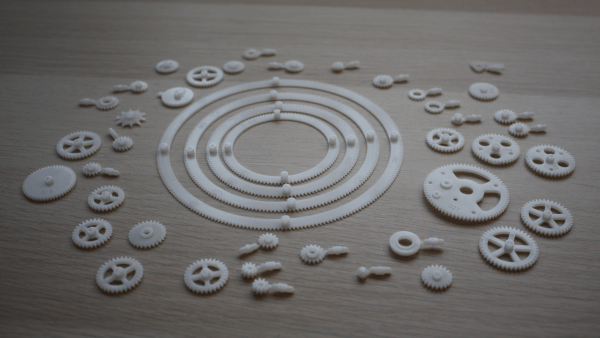
Inquiries About Purchasing Parts
Click here for details regarding purchasing parts for the DIY kit.
Usage and Viewing Guide
Names of each component


How to Use
Connect the USB cable to the USB port on the Stellar Movements, then plug it into a USB port on
your computer or other device.
Turn the switch & speed control knob clockwise until you hear a click; the power will turn on. Adjust the
knob to set your desired speed.
To turn off the power, rotate the switch & speed control knob counterclockwise until you hear a click again.

How to Enjoy: night phase
The night phase indicates the night region on Earth and is always set to be on the opposite side of the Sun.

How to Enjoy: Calendar & Time Scales
The current date is indicated by the night phase protrusion. For example, if the protrusion points to “5” on the calendar, the current month is May. At this time, the month scale also points to “May.”
Time scale behavior is as follows:
Month scale: When changing from Dec → Jan, the Years scale advances by one step.
Years scale: When changing from 10 → 1, the 10 years scale advances by one step.
Neptune moves in sync with the 10 years scale, advancing one step every 10 years.

How to Enjoy: Lunar Phase
The lunar phase shows the illuminated portion of the Moon’s surface as seen from Earth. For example, when the Moon is between Earth and the Sun, the dark portion of the Moon points toward the notch on the scale, indicating a new moon.

How to Enjoy: Zodiac disc
The zodiac disc shows the constellations corresponding to the current month as seen from the Sun’s perspective toward Earth.
For example, when the calendar shows “September,” the corresponding constellations are “VIRGO”.

Orbital Period Table
The planetary orbital periods in Stellar Movements are set based on Earth’s orbital period (1 year), as shown in the table below.
Reference orbital periods are generally consistent across sources. For example, see:Orbital Period Table

Other: Aging and Wear
As Stellar Movements operates, moving parts such as gears will gradually wear down.
This wear increases the load on the motor, which may slightly reduce startup responsiveness and maximum speed.
However, once the initial wear progresses to a certain point, the rate of speed reduction stabilizes.
Please understand that this initial decrease in speed is a characteristic of Stellar Movements.
If the maximum speed drops to less than half within one year of purchase for a completed product, it will be considered a malfunction.
Other: For Quieter Operation
Reducing the operating speed or placing a rubber mat (such as a mouse pad) underneath Stellar Movements can help reduce operating noise.
Other: Storage
Avoid operating or storing the product in environments with high temperature and humidity, direct sunlight, or exposure to vibration and shock.
Q & A
Q. Where can I purchase this product?
A. It is available from our online store and authorized retailers
Q. Can it simulate the positional relationships of the planets?
A. It can only simulate within a very limited range, so it is intended more for enjoying the motion of the planets and gears rather than precise simulation.
Q. Does it correlate with real-time like a clock?
A. No, it does not correlate with real time. It uses a relative time scale based on the Earth’s orbital period around the Sun within Stellar Movements.
Q. How long does assembly take?
A. Approximately 8 hours.
Q. Can I use product photos or the olenoides logo in articles?
A. Please use the photo and logo set stored here: Google Drive
If you require other photos or videos, please contact us.
Q. Can it be purchased outside Japan?
A. We have export experience to countries such as the United States, Canada, Australia, China, Hong Kong, and Taiwan. We do not handle sales to regions that require CE marking, such as the EU and the United Kingdom. For other countries, or for destinations where EMS service is suspended, please contact us by email for further information.